
AWS DevOps Engineer jobs sit at the intersection of three high-demand areas: cloud computing, automation, and software delivery. Companies want faster releases, reliable infrastructure, secure pipelines, and systems that scale without constant manual intervention. That is exactly where AWS DevOps engineers add value.
In 2026, the role is no longer limited to “deployment support.” Modern AWS DevOps engineers are expected to understand cloud architecture, CI/CD pipelines, Infrastructure as Code, observability, containers, security, cost optimization, incident response, and increasingly AI-assisted engineering workflows.
AWS describes the AWS Certified DevOps Engineer Professional credential as validating advanced technical expertise in provisioning, operating, and managing distributed application systems on AWS. The exam focuses on automation, deployment, operations, and reliability across AWS environments. Earning the AWS DevOps Engineer certification is one of the most recognized ways to validate your skills and stand out in a competitive job market.
For learners based in cities with strong IT ecosystems, enrolling in structured AWS DevOps training in Hyderabad is one of the most practical ways to gain hands-on experience with these tools before entering the job market. Hyderabad has emerged as one of India’s top tech hiring hubs, with major companies actively recruiting AWS DevOps engineers from training programs that combine cloud fundamentals with real project work.
For a software training website, AWS DevOps is a strong career topic because it gives learners a practical route into cloud jobs, platform engineering, site reliability engineering, DevSecOps, and automation-focused roles.
What Does an AWS DevOps Engineer Do?
Before diving into responsibilities, it helps to understand what DevOps actually means. What is DevOps? DevOps is a set of practices, cultural philosophies, and tools that combines software development (Dev) and IT operations (Ops). It is implemented to shorten the software development lifecycle, automate repetitive tasks, and deliver applications and features at higher velocity and reliability. When DevOps is implemented on AWS, engineers use cloud-native services and automation to eliminate the silos between development and operations teams.
An AWS DevOps Engineer designs, builds, automates, deploys, monitors, and improves software delivery systems on Amazon Web Services.
They help teams answer questions like:
- How do we deploy code safely?
- How do we reduce manual release work?
- How do we monitor production systems?
- How do we recover quickly from failures?
- How do we automate cloud infrastructure?
- How do we secure CI/CD pipelines?
- How do we scale applications without downtime?
A typical AWS DevOps engineer works with developers, QA engineers, cloud architects, security teams, and operations teams.
Common AWS DevOps Engineer Responsibilities
| Responsibility | What It Means in Real Projects |
|---|---|
| CI/CD pipeline creation | Building automated pipelines using CodePipeline, GitHub Actions, Jenkins, GitLab CI, or similar tools |
| Build automation | Running tests, packaging code, and creating deployable artifacts |
| Deployment automation | Deploying applications to EC2, ECS, EKS, Lambda, Elastic Beanstalk, or Kubernetes |
| Infrastructure as Code | Creating repeatable AWS infrastructure with CloudFormation, CDK, or Terraform |
| Monitoring and alerting | Using CloudWatch, logs, metrics, dashboards, and alarms |
| Incident response | Troubleshooting failed deployments, outages, latency, scaling issues, and infrastructure errors |
| Security automation | Managing IAM roles, secrets, vulnerability scans, and secure pipeline permissions |
| Container operations | Building Docker images, pushing to ECR, running workloads on ECS or EKS |
| Cost optimization | Identifying overprovisioned resources, unused infrastructure, and inefficient scaling patterns |
AWS CodePipeline is a core service in this workflow because it automates the build, test, and deploy phases of a release process whenever code changes occur.
AWS DevOps Engineer Salary in 2026
AWS DevOps salaries vary by country, city, experience, company type, cloud depth, certification, and whether the role includes Kubernetes, platform engineering, security, or SRE responsibilities.
Salary data also varies by source because job titles are not always standardized. Some companies use titles such as:
- AWS DevOps Engineer
- Cloud DevOps Engineer
- DevSecOps Engineer
- Site Reliability Engineer
- Platform Engineer
- Cloud Infrastructure Engineer
- Build and Release Engineer
- AWS Automation Engineer
2026 AWS DevOps Engineer Salary: United States
Glassdoor’s April 2026 data reports an average salary of about $139,925 per year for AWS/DevOps Engineers in the United States, with a typical range between about $114,729 and $172,433 annually.
Robert Half’s 2026 salary guide lists DevOps Engineer salary ranges from approximately $118,000 to $173,750, which aligns closely with the broader market range for experienced DevOps roles.
PayScale reports the average U.S. salary for a Development Operations Engineer at about $114,661 in 2026.
US Salary Interpretation
| Level | Typical 2026 Range | What Employers Usually Expect |
|---|---|---|
| Entry-level / Junior | $80,000–$105,000 | Linux, Git, AWS basics, CI/CD exposure, scripting |
| Mid-level | $105,000–$145,000 | Production AWS experience, IaC, pipelines, monitoring |
| Senior | $145,000–$180,000+ | Architecture, Kubernetes, reliability, security, mentoring |
| Specialist / Lead | $180,000+ | Platform engineering, multi-account AWS, large-scale systems, SRE leadership |
These ranges are practical approximations based on market data. Actual compensation can be higher in major tech hubs, finance, SaaS, AI infrastructure companies, and senior platform engineering roles.
2026 AWS DevOps Engineer Salary: India
Glassdoor’s April 2026 India data reports the average AWS/DevOps Engineer salary at around ₹7,42,500 per year, with a typical range between approximately ₹4,96,750 and ₹13,87,500 annually.
Another Glassdoor India salary result for AWS/DevOps Engineer reports an average of about ₹6,82,500 per year, with top earners reaching approximately ₹40,00,000 in some reported cases.
PayScale reports the average salary for a Development Operations Engineer in India at about ₹996,275 in 2026, with reported pay ranging from about ₹404,000 to ₹3,000,000 depending on experience and profile.
For learners pursuing AWS DevOps training in Hyderabad, the city’s concentration of product companies, IT services firms, and cloud-first startups means strong local hiring demand across all experience levels, from freshers to senior engineers.
India Salary Interpretation
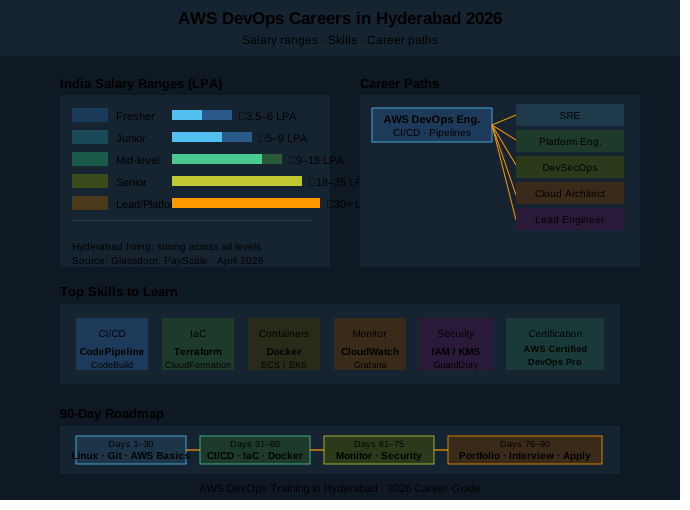
| Level | Typical 2026 Range | What Employers Usually Expect |
|---|---|---|
| Fresher / Entry-level | ₹3.5 LPA–₹6 LPA | Linux, AWS fundamentals, Git, basic CI/CD |
| Junior AWS DevOps | ₹5 LPA–₹9 LPA | EC2, S3, IAM, CodePipeline, Docker basics |
| Mid-level AWS DevOps | ₹9 LPA–₹18 LPA | Terraform/CloudFormation, Kubernetes/ECS, monitoring |
| Senior AWS DevOps | ₹18 LPA–₹35 LPA+ | Architecture, DevSecOps, multi-account AWS, SRE |
| Lead / Platform Engineer | ₹30 LPA+ | Platform strategy, automation frameworks, scaling, governance |
Important Note on Salary Data
Salary portals rely on user-submitted data, job listings, and market estimates. Treat them as guidance, not guarantees. The best way to earn more is to build demonstrable skills in real AWS projects, CI/CD, Infrastructure as Code, containers, monitoring, security, and cloud architecture.
AWS DevOps Engineer Job Market in 2026
AWS DevOps hiring remains strong because companies need engineers who can make cloud delivery faster, safer, and more reliable.
The U.S. Bureau of Labor Statistics reports that the broader computer and information technology occupational group had a median annual wage of $105,990 in May 2024, much higher than the median wage for all occupations.
BLS also reports that software developers had a median annual wage of $133,080 in May 2024, which is relevant because many DevOps roles overlap with software engineering, automation, release engineering, and cloud platform development.
Why Companies Hire AWS DevOps Engineers
| Business Problem | How AWS DevOps Helps |
|---|---|
| Slow software releases | Automated CI/CD pipelines |
| Manual infrastructure setup | Infrastructure as Code |
| Frequent deployment failures | Automated testing and deployment strategies |
| Poor production visibility | Monitoring, logging, tracing, dashboards |
| Security risks in pipelines | IAM, secrets management, vulnerability scanning |
| Cloud cost waste | Right-sizing, scaling policies, cost monitoring |
| Downtime during releases | Blue/green, canary, rolling deployments |
| Developer bottlenecks | Self-service platform engineering |
DORA’s software delivery performance metrics focus on a team’s ability to deliver software safely, quickly, and efficiently, using metrics such as deployment frequency, lead time for changes, change failure rate, and recovery time.
AWS DevOps Engineer Skills Required in 2026
To get hired as an AWS DevOps engineer in 2026, learners need a mix of cloud skills, automation skills, programming knowledge, infrastructure understanding, and operational discipline.
Skill Category 1: AWS Cloud Fundamentals
Every AWS DevOps engineer should understand core AWS services.
| AWS Service | Why It Matters |
|---|---|
| IAM | Controls users, roles, policies, and permissions |
| EC2 | Runs virtual servers |
| S3 | Stores artifacts, logs, backups, and static files |
| VPC | Provides networking foundation |
| RDS | Managed relational databases |
| Lambda | Serverless compute |
| CloudWatch | Monitoring, logs, metrics, alarms |
| CloudTrail | Auditing AWS API activity |
| ECR | Container image registry |
| ECS / EKS | Container orchestration |
| Systems Manager | Operational automation |
| Secrets Manager | Secure credential storage |
| KMS | Encryption key management |
Skill Category 2: CI/CD Pipelines
CI/CD is one of the most important AWS DevOps skills. Understanding how DevOps is implemented through continuous integration and continuous delivery pipelines is a core requirement for any AWS DevOps role. Quality AWS DevOps training in Hyderabad typically emphasizes hands-on CI/CD pipeline building from week one, because it is the skill hiring managers test most directly in interviews.
A good AWS DevOps engineer should know how to:
- Connect source code repositories to pipelines
- Run automated builds
- Run unit tests and integration tests
- Package artifacts
- Deploy to dev, staging, and production
- Use approval gates
- Roll back failed deployments
- Secure pipeline permissions
- Monitor pipeline failures
AWS CodeBuild is a fully managed build service that compiles source code, runs unit tests, and produces deployable artifacts without requiring teams to manage build servers.
AWS CodeDeploy automates application deployments to EC2 instances, on-premises instances, Lambda functions, and ECS services.
Visual: AWS CI/CD Pipeline
Developer Pushes Code
       ↓
GitHub / CodeCommit / Bitbucket
       ↓
AWS CodePipeline
       ↓
AWS CodeBuild
       ↓
Automated Tests
       ↓
Artifact Stored in S3 or ECR
       ↓
AWS CodeDeploy / ECS / EKS / Lambda
       ↓
CloudWatch Monitoring
Skill Category 3: Infrastructure as Code
Infrastructure as Code, or IaC, means defining cloud infrastructure using code instead of creating resources manually.
| Tool | Usage |
|---|---|
| AWS CloudFormation | AWS-native IaC using YAML/JSON templates |
| AWS CDK | AWS infrastructure using programming languages |
| Terraform | Multi-cloud Infrastructure as Code |
| Pulumi | IaC using general-purpose programming languages |
AWS CloudFormation helps teams model, provision, and manage AWS and third-party resources by treating infrastructure as code.
Skill Category 4: Linux and Scripting
AWS DevOps engineers frequently troubleshoot servers, containers, pipelines, and automation scripts. Linux skills are essential.
Key Linux skills: file system navigation, process management, permissions, package installation, shell scripting, logs and systemd, SSH, cron jobs, networking commands.
| Language | Why It Helps |
|---|---|
| Bash | Automation, server tasks, deployment scripts |
| Python | AWS SDK automation, tooling, scripts |
| YAML | CI/CD pipelines, Kubernetes, CloudFormation |
| JSON | AWS policies, API configs, templates |
| JavaScript/TypeScript | CDK and modern cloud tooling |
Skill Category 5: Containers and Kubernetes
Containers are now a major requirement in DevOps jobs. AWS DevOps engineers should understand Docker images, Dockerfiles, containers vs virtual machines, image registries, Amazon ECR, Amazon ECS, AWS Fargate, Kubernetes basics, Amazon EKS, Helm charts, and container logging and monitoring.
Skill Category 6: Monitoring and Observability
Production systems must be observable. AWS DevOps engineers are expected to know how to monitor infrastructure and applications using CloudWatch metrics, CloudWatch Logs, CloudWatch alarms, dashboards, distributed tracing, error monitoring, incident response, service-level indicators and objectives, and log retention and analysis.
Skill Category 7: Security and DevSecOps
DevOps jobs increasingly include security responsibilities. In 2026, hiring teams expect candidates to understand secure automation.
| Security Area | Tools / Concepts |
|---|---|
| Access control | IAM users, roles, policies, permission boundaries |
| Secrets | AWS Secrets Manager, Parameter Store |
| Encryption | KMS, TLS, encrypted storage |
| Audit | CloudTrail, AWS Config |
| Threat detection | GuardDuty |
| Vulnerability scanning | Amazon Inspector, container scanning |
| Pipeline security | Least privilege, token scope, protected branches |
| Compliance | Logging, tagging, change management |
A 2026 report on the CodeBuild-related “CodeBreach” issue highlighted why CI/CD security matters: misconfigured webhook filtering and privileged build triggers can create supply-chain risk, even when core cloud services are secure.
Most Important AWS DevOps Tools to Learn
AWS-Native Tools
| Tool | What It Does |
|---|---|
| AWS CodePipeline | Automates release workflow |
| AWS CodeBuild | Builds and tests code |
| AWS CodeDeploy | Automates deployments |
| AWS CodeArtifact | Stores software packages |
| AWS CodeConnections | Connects AWS tools with GitHub/Bitbucket |
| AWS CloudFormation | Infrastructure as Code |
| AWS CDK | Infrastructure as Code with programming languages |
| Amazon CloudWatch | Monitoring and logging |
| AWS CloudTrail | API audit logging |
| Amazon ECR | Docker image registry |
| Amazon ECS | Container orchestration |
| Amazon EKS | Managed Kubernetes |
| AWS Lambda | Serverless compute |
| AWS Systems Manager | Operations automation |
Industry Tools AWS DevOps Engineers Should Know
| Category | Tools |
|---|---|
| Version control | Git, GitHub, GitLab, Bitbucket |
| CI/CD | Jenkins, GitHub Actions, GitLab CI, CircleCI |
| IaC | Terraform, CloudFormation, CDK |
| Containers | Docker, ECS, EKS, Kubernetes |
| Monitoring | CloudWatch, Prometheus, Grafana, Datadog |
| Security | Trivy, Snyk, Inspector, GuardDuty |
| Configuration | Ansible, Systems Manager |
| Collaboration | Jira, Confluence, Slack, Teams |
Certifications for AWS DevOps Engineer Jobs in 2026
Certifications are not a replacement for projects, but they help learners structure their study and prove baseline knowledge to hiring managers. Earning an AWS DevOps engineer certification signals that you have validated, standardized knowledge across AWS services, automation, deployment, and operations.
Recommended Certification Path
AWS Cloud Practitioner
       ↓
AWS Solutions Architect Associate
       ↓
AWS Developer Associate or SysOps Administrator Associate
       ↓
AWS Certified DevOps Engineer – Professional
The AWS Certified DevOps Engineer Professional exam is the most advanced DevOps credential AWS offers. AWS states that the exam has 75 questions, a 180-minute duration, and costs $300 USD. It validates skills in SDLC automation, configuration management, monitoring, logging, and security on AWS. Good AWS DevOps training in Hyderabad will align its curriculum with this certification path, helping learners build both job-ready skills and exam confidence at the same time.
Which Certification Should Beginners Start With?
| Learner Level | Recommended Certification |
|---|---|
| Complete beginner | AWS Certified Cloud Practitioner |
| Knows AWS basics | AWS Solutions Architect Associate |
| Developer background | AWS Developer Associate |
| Operations background | AWS SysOps Administrator Associate |
| Experienced AWS engineer | AWS Certified DevOps Engineer – Professional |
Certification vs Real Skills
Hiring managers value certifications more when they are supported by GitHub projects, CI/CD pipelines, Terraform or CloudFormation templates, Docker projects, AWS deployment demos, monitoring dashboards, written case studies, and troubleshooting experience.
AWS DevOps Engineer Roadmap for 2026
Phase 1: Learn Foundations
Start with Linux basics, networking basics, Git and GitHub, cloud computing concepts, AWS global infrastructure, IAM fundamentals, and basic scripting.
Beginner Checklist: Linux commands, Git commands, SSH, HTTP/HTTPS basics, DNS basics, AWS account setup, IAM users and roles, EC2 instance launch, S3 bucket usage.
Phase 2: Learn AWS Core Services
Focus on IAM, EC2, S3, VPC, RDS, CloudWatch, Lambda, Load Balancers, Auto Scaling, and Route 53.
Phase 3: Learn CI/CD
Build pipelines with GitHub, AWS CodePipeline, AWS CodeBuild, AWS CodeDeploy, S3 artifact storage, deployment approvals, environment variables, and buildspec files.
Phase 4: Learn Infrastructure as Code
Practice CloudFormation templates, Terraform modules, AWS CDK apps, remote state management, environment-specific deployments, and version-controlled infrastructure.
Phase 5: Learn Containers
Study Docker, Docker Compose, Amazon ECR, ECS, Fargate, Kubernetes basics, and EKS fundamentals.
Phase 6: Learn Monitoring and Security
Practice CloudWatch logs, CloudWatch alarms, dashboards, CloudTrail, IAM least privilege, Secrets Manager, KMS, GuardDuty, and Inspector.
Phase 7: Build Portfolio Projects
Create real projects that prove job readiness.
Portfolio Projects That Help You Get Hired
A strong AWS DevOps portfolio should show that you can build, automate, deploy, monitor, and troubleshoot.
Project 1: Static Website Deployment Pipeline — Deploy a static website to S3 and CloudFront using CI/CD. Skills: GitHub, S3, CloudFront, CodePipeline, CodeBuild, IAM, cache invalidation.
Project 2: Node.js App CI/CD to EC2 — Deploy a Node.js app automatically to EC2. Skills: EC2, CodeDeploy, CodeBuild, CodePipeline, Linux, IAM roles, deployment scripts.
Project 3: Docker App on ECS Fargate — Containerize an app and deploy it to ECS Fargate. Skills: Docker, ECR, ECS, Fargate, Load Balancer, CloudWatch logs, task definitions.
Project 4: Terraform-Based AWS Infrastructure — Create VPC, EC2, S3, IAM, and security groups using Terraform. Skills: Infrastructure as Code, Terraform state, AWS networking, security groups, reusable modules.
Project 5: Serverless CI/CD Pipeline — Deploy a Lambda API using SAM or CloudFormation. Skills: Lambda, API Gateway, SAM, CodePipeline, CloudWatch, IAM.
Project 6: Monitoring Dashboard and Alerting — Create CloudWatch dashboards and alarms for an application. Skills: Metrics, logs, alarms, dashboards, incident response basics.
Project 7: Blue/Green Deployment — Demonstrate safer production releases using blue/green deployment. Skills: Deployment strategy, rollback planning, CodeDeploy, load balancing, production release thinking.
How to Get Hired as an AWS DevOps Engineer in 2026
Step 1: Target the Right Entry Point
| Starting Role | Why It Helps |
|---|---|
| Cloud Support Associate | Builds AWS troubleshooting experience |
| Junior DevOps Engineer | Direct CI/CD and automation exposure |
| Linux System Administrator | Strong operations foundation |
| Build and Release Engineer | Pipeline and release management experience |
| Cloud Engineer | AWS infrastructure experience |
| QA Automation Engineer | Testing and pipeline knowledge |
| Backend Developer | Application and deployment understanding |
Step 2: Build a Skill-Based Resume
Weak: “Worked on AWS and DevOps tools.”
Strong: “Built a CI/CD pipeline using AWS CodePipeline, CodeBuild, and CodeDeploy to automate deployments to EC2, reducing manual release steps and improving deployment consistency.”
Step 3: Show Projects Publicly
Create a GitHub profile with README files, architecture diagrams, deployment steps, screenshots, Terraform or CloudFormation code, CI/CD pipeline screenshots, troubleshooting notes, and cost cleanup instructions.
Step 4: Learn Interview Scenarios
Example questions: How would you deploy a web app to AWS with zero downtime? How would you roll back a failed deployment? How would you secure a CI/CD pipeline? How would you monitor an ECS service? How would you troubleshoot high CPU on EC2? How would you manage secrets in a pipeline? How would you design a multi-environment deployment setup? How would you reduce AWS costs?
Step 5: Prepare Hands-On Demos
Candidates stand out when they can explain and demo a working CI/CD pipeline, a Terraform or CloudFormation template, a Dockerized application, a CloudWatch dashboard, a deployment rollback, an IAM least-privilege policy, and a blue/green deployment.
AWS DevOps Interview Preparation Guide
Technical Topics to Prepare
| Topic | What to Study |
|---|---|
| Git | Branching, merging, pull requests, tags |
| Linux | Processes, permissions, logs, networking |
| AWS IAM | Roles, policies, trust relationships |
| EC2 | AMIs, security groups, user data, autoscaling |
| S3 | Buckets, policies, versioning, static hosting |
| VPC | Subnets, route tables, NAT, internet gateway |
| CI/CD | Build, test, deploy, artifacts, approvals |
| CodePipeline | Stages, actions, triggers |
| CodeBuild | buildspec.yml, artifacts, environment variables |
| CodeDeploy | appspec.yml, deployment groups, rollback |
| Terraform | providers, resources, state, modules |
| Docker | images, containers, volumes, networks |
| ECS/EKS | tasks, services, pods, deployments |
| CloudWatch | logs, metrics, alarms, dashboards |
| Security | least privilege, secrets, encryption |
| Troubleshooting | logs, metrics, failed deployments |
Common Interview Question: Explain CI/CD on AWS
A strong answer: “A typical AWS CI/CD pipeline starts when a developer pushes code to GitHub or CodeCommit. CodePipeline detects the change and triggers CodeBuild. CodeBuild installs dependencies, runs tests, and produces an artifact. The artifact is stored in S3 or an image is pushed to ECR. Then CodeDeploy, ECS, EKS, Lambda, or another deployment target releases the application. CloudWatch monitors logs and metrics after deployment.”
Skills Matrix: Beginner to Job-Ready AWS DevOps Engineer
| Skill Area | Beginner | Job-Ready | Advanced |
|---|---|---|---|
| Linux | Basic commands | Logs, services, permissions | Performance troubleshooting |
| Git | Clone, commit, push | Branching, PR workflow | Release strategy |
| AWS | EC2, S3, IAM basics | VPC, CloudWatch, ECS, Lambda | Multi-account architecture |
| CI/CD | Understand stages | Build real pipelines | Secure, scalable release platforms |
| IaC | Read templates | Write Terraform/CloudFormation | Modular, reusable infrastructure |
| Containers | Build Docker image | Deploy to ECS/EKS | Optimize production workloads |
| Security | Basic IAM | Least privilege, secrets | DevSecOps automation |
| Monitoring | View logs | Create alarms/dashboards | SLOs, incident response |
| Programming | Basic scripts | Python/Bash automation | Internal tools and platform APIs |
AWS DevOps Engineer Career Paths
Path 1: AWS DevOps Engineer — CI/CD, automation, AWS infrastructure, monitoring, deployment reliability.
Path 2: Site Reliability Engineer — Reliability, incident response, observability, performance, automation, service-level objectives.
Path 3: Platform Engineer — Internal developer platforms, self-service infrastructure, golden paths, Kubernetes platforms, developer productivity.
Path 4: DevSecOps Engineer — Pipeline security, cloud security, vulnerability scanning, secrets management, compliance automation.
Path 5: Cloud Architect — Architecture design, multi-account AWS strategy, networking, scalability, governance, cost optimization.
2026 Hiring Trends for AWS DevOps Engineers
Trend 1: DevOps Is Becoming Platform Engineering
Many companies now want DevOps engineers to build internal platforms that make developers more productive, including deployment templates, infrastructure modules, developer portals, self-service environments, monitoring defaults, and security guardrails.
Trend 2: AI Is Changing DevOps Workflows
DORA’s 2025 research focused on AI-assisted software development and how AI affects engineering teams. For AWS DevOps engineers, AI tools may help with writing scripts, explaining logs, generating Terraform templates, creating pipeline YAML, troubleshooting errors, summarizing incidents, and improving documentation. But AI does not replace DevOps fundamentals. Hiring managers still expect candidates to understand systems, networking, security, cloud architecture, deployment failure modes, and production operations.
Trend 3: Security Is Now a Core DevOps Skill
DevSecOps is no longer optional. Candidates who understand pipeline security, IAM, secrets, vulnerability scanning, and supply-chain risk have an advantage.
Trend 4: Kubernetes Helps, But AWS Fundamentals Still Matter
Kubernetes is valuable, especially with EKS, but many companies also use ECS, Lambda, EC2, and managed AWS services. Beginners should not skip AWS basics just to jump into Kubernetes.
Trend 5: Employers Want Proof, Not Just Certificates
Certifications help, but practical projects matter more. A candidate with a working CI/CD project, Terraform code, Docker deployment, and CloudWatch dashboard will usually stand out over someone who only holds an AWS DevOps engineer certification without supporting projects.
Resume Keywords for AWS DevOps Engineer Jobs
Technical Keywords
AWS, DevOps, CI/CD, CodePipeline, CodeBuild, CodeDeploy, CloudFormation, Terraform, AWS CDK, Docker, Kubernetes, ECS, EKS, Fargate, Lambda, EC2, S3, IAM, VPC, CloudWatch, CloudTrail, Secrets Manager, KMS, GitHub Actions, Jenkins, Linux, Bash, Python, Git, Monitoring, Observability, DevSecOps, Infrastructure as Code, Blue/Green Deployment, Canary Deployment, AWS Certified DevOps Engineer Professional.
Outcome-Based Keywords
Automated deployments, reduced manual release effort, improved deployment reliability, implemented monitoring dashboards, created Infrastructure as Code, secured CI/CD pipeline, reduced deployment failures, improved rollback process, optimized AWS infrastructure, built reusable Terraform modules.
LinkedIn Profile Tips for AWS DevOps Job Seekers
Headline Examples
- AWS DevOps Engineer | CI/CD | Terraform | Docker | CloudWatch
- Cloud & DevOps Engineer | AWS | Kubernetes | Infrastructure as Code
- Junior AWS DevOps Engineer | CodePipeline | EC2 | S3 | Linux | Docker
- DevSecOps Engineer | AWS Security | CI/CD | IAM | Automation
Beginner-to-Hired AWS DevOps Study Plan
90-Day Learning Roadmap
Days 1–15: Linux commands, Git and GitHub, networking basics, AWS account setup, IAM, EC2, S3.
Days 16–30: VPC basics, load balancers, Auto Scaling, CloudWatch, CloudTrail, Lambda basics.
Days 31–45: CodePipeline, CodeBuild, CodeDeploy, buildspec.yml, appspec.yml, deployment stages.
Days 46–60: CloudFormation or Terraform, reusable templates, version-controlled infrastructure, dev and staging environments.
Days 61–75: Docker, ECR, ECS or EKS basics, CloudWatch dashboards, alerts and logs.
Days 76–90: Build 2–3 projects, write README files, record demo videos, practice interview questions, update resume and LinkedIn, apply to junior DevOps, cloud engineer, and support roles.
Conclusion: How to Become Job-Ready for AWS DevOps in 2026
AWS DevOps Engineer jobs in 2026 reward people who can combine cloud knowledge with automation, reliability, security, and practical problem-solving.
To get hired, beginners should not only memorize AWS services. They should build real systems: Code → Build → Test → Deploy → Monitor → Improve.
The best job-ready path is:
- Learn Linux, Git, networking, and AWS basics.
- Build CI/CD pipelines with AWS CodePipeline, CodeBuild, and CodeDeploy.
- Learn Infrastructure as Code with Terraform, CloudFormation, or CDK.
- Practice Docker, ECR, ECS, and eventually EKS.
- Use CloudWatch for logs, metrics, alarms, and dashboards.
- Add security with IAM, Secrets Manager, KMS, CloudTrail, and least privilege.
- Build a public portfolio with real AWS projects.
- Prepare for scenario-based interviews.
- Earn the AWS Certified DevOps Engineer Professional certification when ready.
- Apply for junior DevOps, cloud engineer, platform, support, and release engineering roles.
For learners in India, structured AWS DevOps training in Hyderabad offers an accelerated path into this career — combining live instruction, real project work, and interview coaching in a city where AWS DevOps hiring is active and growing year on year.
Understanding what DevOps is and how it is implemented in a real cloud environment is the foundation every successful AWS DevOps engineer builds on. AWS DevOps is not just a tool skill. It is a career path built around automation, ownership, reliability, and continuous improvement. For learners who want a practical cloud career in 2026, it remains one of the most valuable paths in modern software engineering.