
As companies become more dependent on cloud systems, ERP platforms, SaaS applications, cybersecurity tools, payment systems, and automated financial reporting, one question has become critical:
Can the organization trust its IT systems, data, access permissions, change processes, and operational controls?
That is where ITGC, or Information Technology General Controls, becomes important.
For IT audit, risk, compliance, cybersecurity, internal audit, SOX, SOC, and governance professionals, ITGC is one of the most practical skill areas to learn. It connects technology with business risk. It helps auditors verify whether IT systems are secure, reliable, controlled, and compliant.
A strong ITGC course in Hyderabad should not only explain definitions. It should train learners to perform real ITGC audits, understand control testing, review evidence, identify gaps, document findings, and communicate audit results clearly.
This guide explains what ITGC is, ITGC full form, key ITGC controls, ITGC audit process, career scope, salary potential, course syllabus, and how to choose the best ITGC training in Hyderabad.
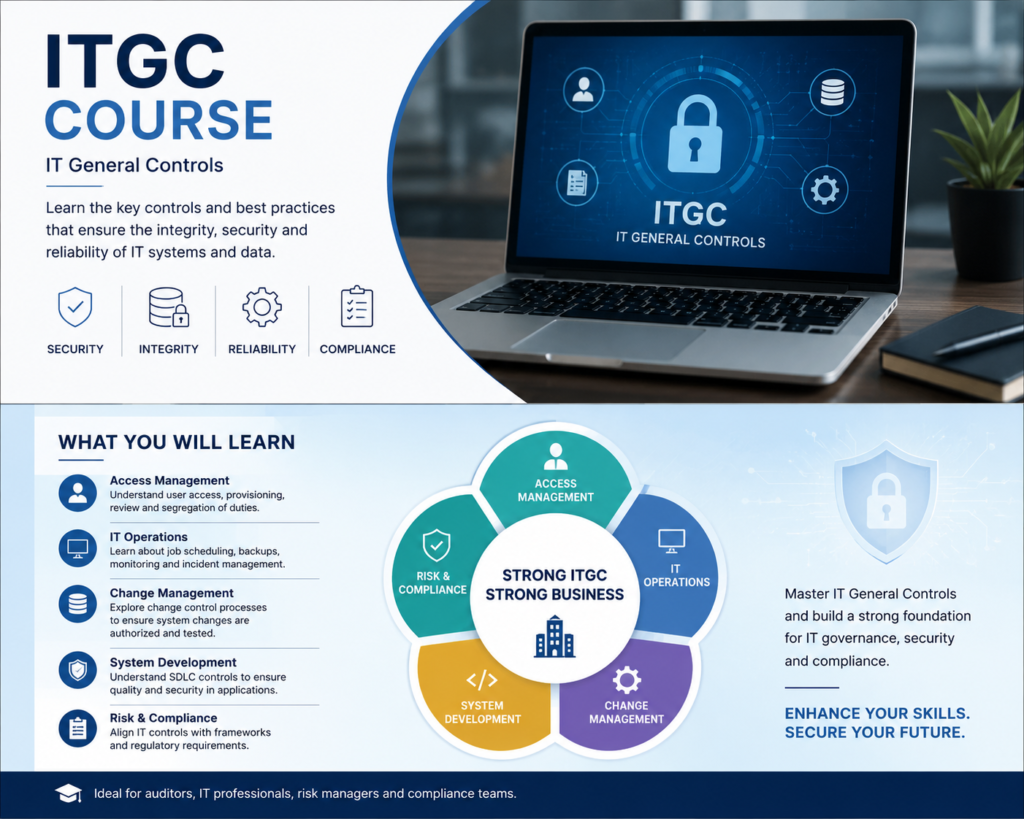
What Is ITGC?
ITGC full form: Information Technology General Controls
ITGC refers to the broad controls that help ensure an organization’s IT environment is secure, reliable, available, and properly managed.
In simple words:
ITGC controls are the basic technology controls that protect systems, data, users, applications, and IT operations across an organization.
ITGCs are not limited to one application. They support the entire IT environment. They are important because business processes such as finance, payroll, procurement, customer management, inventory, banking, billing, and reporting often depend on IT systems.
SailPoint describes IT general controls as internal policies that govern how an organization’s technology is acquired, architected, deployed, used, and maintained. Key functions include access control, user account creation, data management, infrastructure, applications, and data security.
MetricStream explains that IT General Controls form the foundation for operational controls and regulatory compliance, with common components including access controls, change management, backup and recovery, and system operations.
Why ITGC Is Important
ITGC is important because weak IT controls can affect financial reporting, security, compliance, business continuity, and customer trust.
For example:
| Weak IT Control | Possible Risk |
| No access review | Ex-employees may still access critical systems |
| Weak password policy | Unauthorized users may compromise systems |
| Poor change management | Unapproved code changes may break applications |
| No backup testing | Data may not be recoverable after failure |
| Incomplete audit logs | Incidents may be difficult to investigate |
| Shared admin IDs | Accountability becomes weak |
| No segregation of duties | One person may initiate and approve risky changes |
ITGCs are especially important in audits related to:
- SOX compliance
- SOC 1 audits
- SOC 2 audits
- Internal audits
- External audits
- Financial reporting controls
- Cybersecurity audits
- ISO 27001 readiness
- IT risk assessments
- Data privacy compliance
- Vendor risk reviews
- Enterprise risk management
AICPA states that a SOC 2 examination reports on controls at a service organization that are relevant to security, availability, processing integrity, confidentiality, or privacy.
ITGC Full Form and Meaning
| Term | Meaning |
| ITGC | Information Technology General Controls |
| ITAC | Information Technology Application Controls |
| GITC | General IT Controls, often used interchangeably with ITGC |
| IT Audit | Independent review of IT systems, controls, risks, and governance |
| SOX ITGC | IT general controls tested as part of Sarbanes-Oxley compliance |
| SOC ITGC | IT controls reviewed in SOC 1 or SOC 2 audit engagements |
In many job descriptions, you may see terms such as:
- ITGC audit
- SOX ITGC testing
- IT general controls
- GITC controls
- IT audit controls
- access control testing
- change management testing
- logical access review
- IT operations review
- compliance testing
These terms are closely related.
ITGC Audit: What Does It Mean?
An ITGC audit is a structured review of IT controls to check whether they are designed properly and operating effectively.
An ITGC audit usually answers questions like:
- Are only authorized users able to access systems?
- Are privileged users monitored?
- Are application changes approved before deployment?
- Are backups performed and tested?
- Are incidents tracked and resolved?
- Are systems monitored for failures?
- Are audit logs retained?
- Are user access reviews completed?
- Are terminated employees removed on time?
- Are developers restricted from making direct production changes?
ISACA provides IT audit resources, publications, training, and best practices to help professionals improve audit processes and ensure compliance.
Why Hyderabad Is a Strong Location for ITGC Training
Hyderabad is one of India’s major technology and corporate service hubs. It has a strong presence of IT companies, global capability centers, consulting firms, financial services operations, cybersecurity teams, cloud operations teams, and audit support teams.
For learners in Hyderabad, ITGC training can be useful for roles in:
- IT audit
- Internal audit
- SOX compliance
- SOC audit support
- Risk advisory
- GRC
- Cybersecurity audit
- Cloud compliance
- ERP audit
- Data privacy compliance
- Vendor risk management
Glassdoor’s salary data for Hyderabad reports IT Auditor base pay around ₹8L–₹18L per year, with an average base pay around ₹10L per year, based on data last updated in November 2025.
That does not mean every beginner will earn that immediately. Salary depends on experience, certifications, domain knowledge, communication skills, audit exposure, and hands-on tools. But it does show that IT audit is a serious career path, not just a theoretical compliance subject.
Who Should Take an ITGC Course in Hyderabad?
A well-designed ITGC course is useful for both technical and non-technical professionals.
Best Fit Learners
| Learner Type | Why ITGC Helps |
| Commerce graduates | Builds a bridge from accounting/audit to IT risk |
| MBA finance students | Helps enter risk advisory and compliance roles |
| B.Com / M.Com graduates | Useful for audit, SOX, SOC, and compliance careers |
| B.Tech / MCA graduates | Adds audit and governance skills to technical knowledge |
| Internal auditors | Helps expand from process audit to IT audit |
| Cybersecurity beginners | Builds compliance and control-testing foundation |
| CA / CMA / ACCA aspirants | Useful for IT audit and financial control testing |
| Working professionals | Helps move into GRC, risk, compliance, and audit roles |
| Freshers | Good entry point into IT audit and compliance support roles |
Ideal Job Roles After ITGC Training
- IT Auditor
- ITGC Analyst
- SOX Compliance Analyst
- SOC Audit Associate
- GRC Analyst
- Internal Audit Associate
- Risk and Controls Analyst
- Cybersecurity Audit Associate
- Compliance Analyst
- IT Risk Consultant
- ERP Audit Associate
- Control Testing Analyst
What Makes the Best ITGC Course in Hyderabad?
The best ITGC course in Hyderabad should be practical, audit-oriented, and career-focused. It should not only teach textbook definitions. It should help students understand how real audits are planned, executed, documented, reviewed, and reported.
A Strong ITGC Course Should Include
| Course Feature | Why It Matters |
| ITGC fundamentals | Helps beginners understand audit language |
| Real control examples | Makes concepts practical |
| SOX, SOC, ISO, COBIT awareness | Builds framework knowledge |
| Access control testing | One of the most common ITGC areas |
| Change management testing | Essential for application and infrastructure audits |
| IT operations testing | Covers backups, jobs, monitoring, incidents |
| Evidence review | Helps learners understand audit documentation |
| Workpaper preparation | Required in real audit jobs |
| Risk and control matrix | Core audit deliverable |
| Practical assignments | Builds confidence |
| Interview preparation | Helps learners get hired |
| Resume guidance | Converts learning into employability |
Core ITGC Controls Every Learner Must Know
Most ITGC audits focus on a few major control areas.
1. Logical Access Controls
Logical access controls ensure that only authorized users can access systems, applications, databases, and infrastructure.
Examples of Logical Access Controls
| Control | What It Checks |
| User access provisioning | New users are approved before access is granted |
| User access deprovisioning | Ex-employees are removed on time |
| Periodic access review | Managers review user access regularly |
| Privileged access review | Admin access is monitored and approved |
| Password controls | Password rules meet policy requirements |
| MFA controls | Multi-factor authentication is enabled where required |
| Segregation of duties | Conflicting access is prevented |
2. Change Management Controls
Change management controls ensure that changes to applications, databases, infrastructure, and configurations are approved, tested, and implemented properly.
Examples of Change Management Controls
| Control | What It Checks |
| Change request approval | Changes are approved before development |
| Testing evidence | Changes are tested before production |
| UAT approval | Business users approve critical changes |
| Production approval | Deployment is authorized |
| Emergency change review | Emergency changes are reviewed later |
| Developer production access | Developers do not directly modify production |
| Version control | Code changes are tracked |
3. IT Operations Controls
IT operations controls ensure that systems are monitored, backed up, restored, and operated reliably.
Examples of IT Operations Controls
| Control | What It Checks |
| Backup monitoring | Backups are completed successfully |
| Backup restoration testing | Data can actually be restored |
| Batch job monitoring | Scheduled jobs run correctly |
| Incident management | Incidents are logged and resolved |
| Problem management | Root causes are identified |
| System monitoring | Critical systems are monitored |
| Disaster recovery testing | Recovery plans are tested |
4. Program Development Controls
Program development controls focus on new system implementation, application development, SDLC governance, and major system changes.
Examples
- Business requirement approval
- Design review
- Development controls
- Testing documentation
- Security review
- Data migration validation
- Go-live approval
- Post-implementation review
5. Data Center and Infrastructure Controls
These controls review infrastructure, physical security, environment management, and technology operations.
Examples include:
- Physical access to server rooms
- CCTV and visitor logs
- Fire suppression systems
- Environmental monitoring
- Network access controls
- Server hardening
- Patch management
- Vulnerability remediation
ITGC vs ITAC: What Is the Difference?
Beginners often confuse ITGC and ITAC.
| Topic | ITGC | ITAC |
| Full form | IT General Controls | IT Application Controls |
| Scope | Applies across IT environment | Applies inside a specific application |
| Example | User access review for SAP | Invoice amount validation in SAP |
| Audit focus | Access, change, operations, infrastructure | Input, processing, output controls |
| Purpose | Ensure IT environment is reliable | Ensure application transactions are accurate |
ISACA’s discussion of ITGC and IT application controls explains that these control categories provide value by improving IT governance knowledge and control maturity.
ITGC and Major Compliance Frameworks
A good ITGC course should explain how ITGC connects to major compliance frameworks.
1. SOX Compliance
SOX focuses on the reliability of financial reporting. ITGCs become important when financial reporting depends on IT systems.
Examples:
- ERP access controls
- Change management for financial applications
- Database access controls
- Report logic controls
- Backup and recovery for financial systems
MetricStream explains that SOX controls are internal measures established to ensure transparency, accuracy, and integrity of financial reporting.
2. SOC 1 and SOC 2
SOC reports are used to provide assurance over controls at service organizations.
AICPA says SOC offerings provide assurance reports that help users assess and address risks related to outsourcing services.
AICPA states that SOC 2 examinations cover controls relevant to security, availability, processing integrity, confidentiality, or privacy.
3. COBIT
COBIT is widely used in IT governance, risk, and control discussions. ITGC learners do not need to master COBIT on day one, but they should understand how governance frameworks support control design, audit planning, and risk assessment.
ISACA’s CISA certification is globally recognized for professionals who audit, control, monitor, and assess IT and business systems.
4. COSO Internal Control Framework
COSO is important for internal control and financial reporting environments. COSO says effective internal controls have value beyond compliance and can help organizations operate with confidence and integrity.
For ITGC learners, COSO helps explain why IT controls matter to business objectives, not just technology operations.
5. ISO 27001 and Cybersecurity Frameworks
ITGC overlaps with cybersecurity in areas such as access management, monitoring, incident response, backup, change control, and asset protection.
A course that includes ISO 27001, cybersecurity basics, or NIST Cybersecurity Framework concepts can help learners understand how audit and security connect.
Suggested ITGC Course Syllabus for Hyderabad Learners
A career-focused ITGC course should cover the following modules.
Module 1: Introduction to IT Audit and ITGC
- What is IT audit?
- What is ITGC?
- ITGC full form and meaning
- Why ITGC matters
- ITGC vs ITAC
- IT audit lifecycle
- Role of internal audit, external audit, and compliance teams
Module 2: Risk, Control, and Compliance Basics
- Risk definition
- Control objective
- Control activity
- Preventive vs detective controls
- Manual vs automated controls
- Key controls vs non-key controls
- Control design effectiveness
- Control operating effectiveness
- Audit evidence
Module 3: Logical Access Controls
- User access provisioning
- User access modification
- User termination testing
- Privileged access review
- Password policy review
- MFA review
- Segregation of duties
- Access recertification
Module 4: Change Management Controls
- Change request process
- Standard changes
- Normal changes
- Emergency changes
- Testing evidence
- UAT approval
- Production deployment approval
- Developer access to production
- Version control basics
Module 5: IT Operations Controls
- Backup controls
- Restoration testing
- Job monitoring
- Incident management
- Problem management
- System monitoring
- Disaster recovery
- Business continuity
Module 6: Infrastructure and Security Controls
- Server controls
- Network controls
- Database controls
- Physical security
- Patch management
- Vulnerability management
- Logging and monitoring
- Endpoint security basics
Module 7: SOX ITGC Testing
- SOX overview
- Financial reporting systems
- Key systems and in-scope applications
- Risk and control matrix
- Walkthroughs
- Design effectiveness testing
- Operating effectiveness testing
- Deficiency evaluation
Module 8: SOC 1 and SOC 2 Audit Basics
- SOC 1 vs SOC 2
- Type 1 vs Type 2 reports
- Trust services criteria
- Common SOC 2 control areas
- Evidence collection
- Client request lists
- Audit documentation
Module 9: Audit Documentation and Workpapers
- Audit planning
- Evidence request list
- Population and sampling
- Test procedures
- Workpaper preparation
- Exception documentation
- Management response
- Remediation tracking
Module 10: Practical Case Study
- Sample company background
- In-scope systems
- Risk control matrix
- Access testing
- Change testing
- Backup testing
- Audit finding preparation
- Final audit report summary
Practical ITGC Audit Example for Beginners
Let us take a simple example.
Scenario
A company uses an ERP system for finance and accounting. The auditor wants to test whether terminated employees are removed from the ERP system on time.
Control
“User access for terminated employees is removed within 24 hours of termination.”
Evidence Required
- Employee termination report
- ERP user list
- Access removal tickets
- HR termination date
- Access disablement date
- Approval evidence
Possible Finding
“Access for 3 out of 25 terminated employees was removed after more than 10 days, increasing the risk of unauthorized access to financial systems.”
Recommendation
“Management should automate HR-to-IT termination notifications and perform weekly access reconciliation.”
This is the kind of practical learning a strong ITGC course should provide.
ITGC Course in Hyderabad: Online vs Classroom Training
Both formats can work. The best choice depends on the learner’s schedule, learning style, and career goals.
| Factor | Classroom ITGC Course | Online ITGC Course |
| Interaction | High face-to-face interaction | Depends on live sessions |
| Flexibility | Fixed schedule | More flexible |
| Best for | Local students and freshers | Working professionals |
| Practical labs | Possible if structured well | Possible through assignments |
| Recording access | Not always available | Often available |
| Networking | Local peer group | Wider audience |
| Interview support | Depends on institute | Depends on trainer |
For Hyderabad learners, Ameerpet and online training providers often appear in local searches for IT audit, SOX, SOC, and ITGC training. Examples of local course pages mention ITGC, IT audit, SOC 1, SOC 2, SOX, cyber audit, practical projects, and career-focused training.
However, before enrolling, learners should verify trainer experience, syllabus depth, practical assignments, placement support claims, and whether the course includes real audit documentation practice.
How to Choose the Best ITGC Course in Hyderabad
Use this checklist before joining any ITGC training program.
1. Check Whether the Course Covers Real Audit Work
The course should teach:
- Risk and control matrix
- Audit planning
- Walkthroughs
- Evidence request lists
- Sampling
- Test procedures
- Workpaper documentation
- Exception reporting
- Remediation tracking
2. Check Whether ITGC Controls Are Taught Practically
Avoid courses that only explain theory. The best ITGC training should include practical testing for:
- Access provisioning
- Access removal
- Privileged access
- Password settings
- Change approvals
- Emergency changes
- Backup monitoring
- Incident tickets
- Job monitoring
- Disaster recovery testing
3. Check Trainer Background
A good ITGC trainer should ideally have experience in:
- IT audit
- SOX audit
- SOC audit
- Internal audit
- Big 4 / consulting / corporate audit
- GRC
- Cybersecurity compliance
- ERP controls
- Cloud controls
4. Check Placement and Interview Support
A career-focused ITGC course should help with:
- Resume preparation
- LinkedIn profile
- Mock interviews
- Scenario-based questions
- Audit documentation samples
- Job role explanation
- Interview assignments
5. Check Whether Frameworks Are Included
The course should introduce:
- SOX
- SOC 1
- SOC 2
- COSO
- COBIT
- ISO 27001
- CISA basics
- Risk management concepts
ITGC Course Comparison Matrix
Use this table to compare different ITGC training providers in Hyderabad.
| Selection Criteria | Poor Course | Average Course | Best Course |
| ITGC basics | Definitions only | Explains control areas | Explains with real audit examples |
| Practical work | None | Some examples | Workpapers, samples, evidence testing |
| Framework coverage | Limited | SOX/SOC overview | SOX, SOC, COSO, COBIT, ISO, CISA awareness |
| Trainer profile | Unknown | Basic audit exposure | Real IT audit/compliance experience |
| Interview preparation | Not included | Basic questions | Scenario-based interview practice |
| Case studies | None | One or two examples | End-to-end audit case study |
| Documentation | PPT only | Notes included | Templates, workpapers, RCMs |
| Career support | Generic | Resume tips | Resume, LinkedIn, mock interviews |
| Best for | Theory learners | Beginners | Job-focused audit professionals |
ITGC Career Opportunities After Training
ITGC training can open doors to several career paths.
Entry-Level Roles
| Role | Typical Work |
| IT Audit Associate | Supports control testing and evidence review |
| ITGC Analyst | Tests access, change, and operations controls |
| Compliance Analyst | Supports control documentation and compliance requests |
| GRC Associate | Works on governance, risk, and compliance activities |
| SOC Audit Support Associate | Supports SOC 1/SOC 2 evidence collection |
| SOX Testing Analyst | Performs SOX control testing |
Mid-Level Roles
| Role | Typical Work |
| IT Auditor | Plans and executes IT audits |
| Senior ITGC Analyst | Leads control testing and issue tracking |
| Risk Advisory Consultant | Works with clients on audit and compliance |
| Cybersecurity Auditor | Reviews security controls and compliance |
| Internal Auditor – IT | Conducts IT risk reviews |
| SOX IT Controls Specialist | Manages SOX ITGC testing |
Advanced Roles
| Role | Typical Work |
| IT Audit Manager | Leads audit teams and stakeholder communication |
| GRC Manager | Oversees governance, risk, and compliance programs |
| IT Risk Manager | Owns technology risk management |
| Cyber GRC Lead | Leads cyber risk and compliance initiatives |
| CISO Office Governance Lead | Supports security governance and control assurance |
Salary Scope for ITGC and IT Audit Professionals
Salary depends on location, company, experience, certifications, communication skills, audit knowledge, and technical exposure.
For Hyderabad specifically, Glassdoor reports IT Auditor salaries with average base pay around ₹10L per year, with a reported range of ₹8L–₹18L per year.
For broader India data, PayScale reports the average Development Operations / related audit-compliance technology salary data differently by role, while Glassdoor’s IT audit and compliance salary entries may have limited sample sizes. Always interpret salary portals carefully because small sample sizes can distort numbers.
Practical Salary Bands for ITGC Professionals in India
| Experience Level | Possible Role | Approximate Range |
| Fresher | IT audit trainee / compliance associate | ₹3 LPA–₹5 LPA |
| 1–3 years | ITGC analyst / SOX testing analyst | ₹5 LPA–₹9 LPA |
| 3–6 years | IT auditor / senior analyst | ₹9 LPA–₹16 LPA |
| 6–10 years | IT audit manager / GRC consultant | ₹16 LPA–₹28 LPA |
| 10+ years | GRC manager / IT risk lead | ₹25 LPA+ |
These are general market-oriented ranges, not guaranteed salaries.
Certifications That Complement ITGC Training
An ITGC course can be the foundation. Certifications can help build credibility.
Useful Certifications
| Certification | Best For |
| CISA | IT audit, controls, assurance |
| ISO 27001 Lead Auditor | Information security audit |
| CRISC | IT risk management |
| CISM | Security governance |
| CISSP | Advanced cybersecurity leadership |
| CIA | Internal audit |
| CPA / CA / ACCA | Financial audit and SOX roles |
| SOC 2 training | Service organization compliance |
| COBIT Foundation | IT governance |
ISACA describes CISA as a certification for professionals who audit, control, monitor, and assess an organization’s IT and business systems.
ISACA’s CISA exam content outline covers five domains, including Information System Auditing Process, Governance and Management of IT, Information Systems Acquisition, Development and Implementation, Information Systems Operations and Business Resilience, and Protection of Information Assets.
ITGC Course Roadmap for Beginners
60-Day Learning Plan
Days 1–10: IT Audit Foundations
- What is IT audit?
- What is ITGC?
- ITGC full form
- ITGC vs ITAC
- Risk and control basics
- Audit terminology
Days 11–20: Logical Access Controls
- User provisioning
- User termination
- Privileged access
- Password policy
- Access review
- Segregation of duties
Days 21–30: Change Management Controls
- Change tickets
- Approval flow
- Testing evidence
- UAT
- Emergency changes
- Production deployment
Days 31–40: IT Operations Controls
- Backups
- Batch jobs
- Incident management
- Monitoring
- Disaster recovery
- Business continuity
Days 41–50: SOX, SOC, and Frameworks
- SOX basics
- SOC 1 vs SOC 2
- COSO
- COBIT
- ISO 27001
- CISA overview
Days 51–60: Practical Case Study and Interview Prep
- Build a risk control matrix
- Test sample controls
- Document workpapers
- Write findings
- Prepare interview answers
- Build resume and LinkedIn profile
ITGC Interview Questions for Freshers and Professionals
Basic Questions
- What is ITGC?
- What is ITGC full form?
- What is the difference between ITGC and ITAC?
- What are the major ITGC controls?
- What is logical access control?
- What is change management control?
- What is an audit finding?
- What is audit evidence?
- What is control design effectiveness?
- What is control operating effectiveness?
Intermediate Questions
- How do you test user access provisioning?
- How do you test terminated user access removal?
- What evidence is required for change management testing?
- What is an emergency change?
- How do you test privileged access?
- What is segregation of duties?
- What is a risk control matrix?
- What is the difference between SOX and SOC 2?
- What is the difference between Type 1 and Type 2 SOC reports?
- How do you document an exception?
Scenario-Based Questions
- A terminated employee still has access after 15 days. What will you do?
- A change was moved to production without approval. How will you report it?
- Backup jobs failed for three days. What is the risk?
- Developers have admin access to production. Why is this a concern?
- The client cannot provide evidence for access review. What is your audit conclusion?
Sample Resume Bullet Points for ITGC Learners
Fresher Resume Bullets
- Completed practical training in ITGC audit covering logical access, change management, IT operations, and audit documentation.
- Prepared sample risk control matrix and audit workpapers for access provisioning, terminated user review, and change management testing.
- Gained understanding of SOX, SOC 1, SOC 2, COSO, COBIT, and IT audit lifecycle.
- Practiced evidence review, exception documentation, and audit finding preparation using sample case studies.
Experienced Resume Bullets
- Performed ITGC control testing across access management, change management, and IT operations for business-critical applications.
- Reviewed user access listings, change tickets, backup reports, incident records, and privileged access evidence.
- Documented audit workpapers, identified control gaps, and supported remediation tracking with process owners.
- Assisted in SOX and SOC audit readiness by validating control design and operating effectiveness.
Best ITGC Course in Hyderabad: Final Selection Checklist
The best ITGC course is not simply the one with the most marketing claims. It is the one that helps learners confidently answer:
- What is ITGC?
- What are ITGC controls?
- How is an ITGC audit performed?
- What evidence should be reviewed?
- How are exceptions documented?
- How do SOX, SOC, and internal audits use ITGC?
- How do I explain this in an interview?
FAQ
1. What is ITGC?
ITGC stands for Information Technology General Controls. These are controls that help ensure IT systems are secure, reliable, available, and properly managed.
2. What is ITGC full form?
The full form of ITGC is Information Technology General Controls.
3. What are ITGC controls?
Common ITGC controls include logical access controls, change management controls, IT operations controls, backup controls, incident management controls, privileged access controls, and infrastructure controls.
4. What is an ITGC audit?
An ITGC audit is a review of IT general controls to check whether they are properly designed and operating effectively. It usually includes access testing, change management testing, operations testing, and evidence review.
5. Who should learn ITGC?
ITGC is useful for commerce graduates, B.Tech graduates, MBA finance students, internal auditors, cybersecurity beginners, CA aspirants, compliance professionals, and anyone interested in IT audit or GRC careers.
6. Is ITGC a technical course?
ITGC is partly technical and partly audit-focused. You do not need to be a programmer, but you should understand systems, access, applications, basic IT operations, security, and audit documentation.
7. Is ITGC good for freshers?
Yes. ITGC can be a good entry point for freshers who want careers in IT audit, SOX compliance, SOC audit, GRC, risk advisory, and cybersecurity compliance.
8. What jobs can I get after an ITGC course?
You can apply for roles such as IT Audit Associate, ITGC Analyst, SOX Compliance Analyst, GRC Associate, SOC Audit Support Associate, Risk and Controls Analyst, and Compliance Analyst.
9. Is CISA required for ITGC jobs?
CISA is not always required for entry-level jobs, but it is highly respected in IT audit careers. ISACA describes CISA as a certification for professionals who audit, control, monitor, and assess IT and business systems.
10. What should the best ITGC course in Hyderabad include?
It should include ITGC fundamentals, logical access testing, change management testing, IT operations testing, SOX and SOC basics, risk control matrix preparation, audit workpapers, practical case studies, and interview preparation.
Conclusion: Choosing the Best ITGC Course in Hyderabad
The best ITGC course in Hyderabad should help learners move from theory to real audit readiness.
For IT audit and compliance professionals, ITGC is one of the most valuable foundations to build. It helps you understand how technology risk affects business operations, financial reporting, cybersecurity, and regulatory compliance.
For beginners, ITGC offers a practical career path into IT audit, GRC, risk advisory, SOC audit, SOX compliance, and cybersecurity audit. For working professionals, it can help upgrade audit, finance, compliance, and technology skills into a more specialized and higher-value career direction.
A strong ITGC course in Hyderabad should combine audit concepts, real control testing, practical documentation, compliance frameworks, case studies, and interview preparation. That is what makes ITGC training truly job-focused.