ITGC

ITGC – IT General Controls related blog posts covering audit checklists, SOX controls, implementation best practices and compliance.

itgc course

Top ITGC Trends for 2026: A Simple Guide for Future IT Auditors

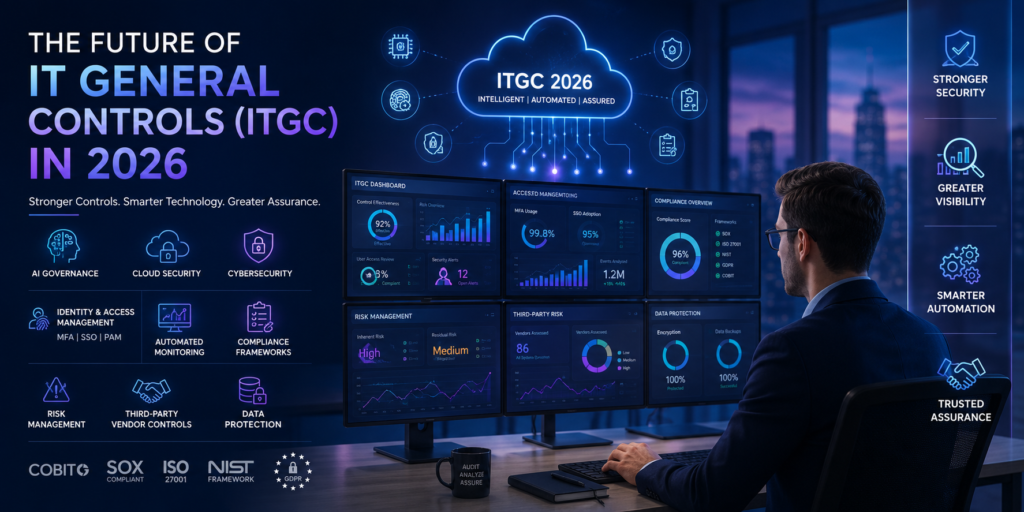
IT Technology is rapidly evolving. Only a few years ago, many companies were focused solely on the basics of system access controls and cybersecurity. Now, businesses employ a plethora of tools such as cloud applications, AI, automation, and tools developed for flexible work environments. These tools have shifted the business world once again, making IT General Controls (ITGC) more imperative. In the age of rapidly evolving technology, understanding the changes and patterns in ITGC will give you a competitive advantage in your desired career in IT audit, risk management, compliance, or cybersecurity. This blog will present the top trends in ITGC for 2026 in an informal and easy-to-read style. To Start Ravi is a recent commerce graduate and new employee at a large multinational company. His first few days on the job were overwhelming and filled with new jargon like ITGC, SOX compliance, access management, and change management. One of his managers said at the end of the day: “Imagine how a building would be without a foundation. It would be a huge risk for everyone. The same is for a company with poor IT controls. Everything from your systems, company data, and even financial reporting will be at a huge risk.” That one analogy gave Ravi the push he needed to start his research on ITGC and find that there is a global investment in IT controls and compliance. Now, what are the main trends of ITGC for 2026? 1. The Governance of AI Will Be Incorporated into ITGC AI is now ubiquitous. Companies use AI in customer service, financial analysis, coding, and even to make business decisions. However, AI has new challenges like: In 2026, it is expected ITGC teams will focus more on AI controls, and auditors will check if companies implement governance to manage AI. Corporations will focus on controls for: All of the above will lead to the creation of new jobs for IT auditors and compliance specialists. 2. Cloud Security Controls Are Increasing More companies are moving their operations from on-premises data centers to the cloud, such as AWS, Azure, and Google Cloud. Cloud technology can lead to greater efficiency, but they come with new problems. ITGC teams focus on: More and more companies are now “cloud-first,” and in 2026, the cloud market will still require the most ITGC focus. Those who know both elements will have significant job market advantage. 3. Automatic Monitoring Replaces Manual Control Checks Before, controls were checked regularly, but the activities to do so were very resource intensive. Now, tools can allow controls to be checked automatically. For example: Automatic monitoring can help identify controls issues proactively. By 2026, most organizations will adopt monitoring technology for control automation, making ITGC controls faster and more accurate. 4. Identity and Access Management Becomes Stronger One crucial area of ITGC is user access management. Organizations need to make sure: With remote work being the norm, more focus has been put on access management. Organizations utilize: Due to the increase in cyber threats, access control is a key focus in ITGC for 2026. 5. Cybersecurity and ITGC Collaborate Historically, cybersecurity and ITGC operated in silos. Currently, the focus is on the systems and data protection which is the ultimate end goal of both functions. Therefore, the following has been observed: The outcome of this systems convergence is improved resilience of the organization and governance. Why More People Are Training In ITGC The need for skilled ITGC professionals is increasing. Organizations are seeking individuals that are able to do: This increase in demand for skilled workers has led more graduates and employees to choose these specializations. In case you are considering a career in ITGC, enrolling in an ITGC training in Hyderabad is a good option. This type of training allows entry-level employees to understand practical topics, like access management, change management, backup controls, and audit testing. Learning by doing is the best way to simplify the understanding and application of complex topics. 6. Compliance Requirements Become More Burdensome Increased legislative and regulatory data protection and information security requirements mean organizations now need to show they have appropriate protective measures. The majority of requirements will concern: In 2026, auditors will focus more on assessing whether organizations have met these requirements. Well-defined ITGC frameworks allow organizations to achieve compliance and limit the risks to the business. 7. Increasing Focus on Managing Third-Party Risk Many organizations depend on third parties. Those third parties may provide: If those third parties have a security incident, the organization can be impacted. For this reason, ITGC teams are focusing more on assessing: The management of third-party risk will continue to be one of the most rapidly expanding service lines in IT audit. 8. ITGC Testing Becomes More Automated Manual testing of ITGCs is a repetitive, resource-draining activity. Many organizations are investing in technology to: The focus of IT auditors will continue to shift from testing controls towards providing more strategic advice. Building a Career in ITGC in 2026 Let us return to Ravi’s story. After several months of learning about ITGC, Ravi knew this was the right career path. Ravi observed that the following roles were available in the job market: To develop his skills, Ravi joined an ITGC course in Hyderabad. He gained knowledge on practical audit scenarios, control testing, compliance, and risk assessment. It took Ravi a year to gain the needed confidence to complete ITGC reviews and work on audit assignments. His story proves that dedication to practice and a desire to learn will always lead to opportunities and a thriving career. Skills Needed for Future ITGC Professionals Aiming for success in 2026 and beyond, individuals are advised to learn: Technical Knowledge Understanding of operating systems, databases, and the cloud, as well as foundational cybersecurity and audit knowledge. Control Testing, Risk Assessment Knowledge on how to collect and document audit evidence. Speaking and Writing Skills These will be useful, as IT auditors communicate with both the technical and corporate sides of the business, as well as

Top ITGC Trends for 2026: A Simple Guide for Future IT Auditors Read More »

IT general controls

Top 5 IT General Controls Every Auditor Should Know

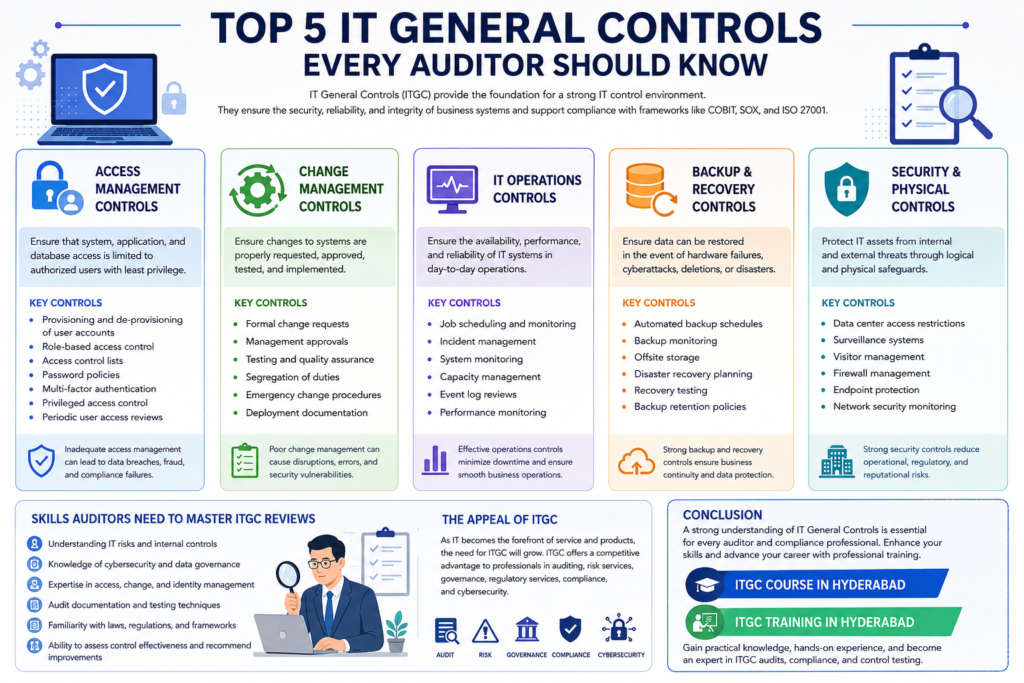
Businesses rely so much on information systems that auditors need to realize just how essential IT General Controls (ITGC) are. They understand the security, reliability, and integrity of business systems. IT General Controls (ITGC) provide the baseline, the building blocks of a business’s IT control environment. They help the business system’s data and processes from the risks of unauthorized access, failures and fraud. Strong ITGC help a business meet compliance and effective control objectives according to the frameworks of COBIT, SOX, and ISO 27001. For those that want to be IT auditors, internal auditors, compliance and/or risk management professionals, understanding ITGC is important. This article discusses the top five IT General Controls that every IT auditor should understand. What are IT General Controls? IT General Controls are the procedures and policies that focus on the confidentiality, accuracy, and availability of information control systems. They can be found in any IT environment in a large business and help application controls, business process controls, and organizational process IT systems. They include access controls, system operation controls, and controls for system backups and security. Poor ITGCs expose the business to operational disruptions, data loss, legal disputes, and false financial statements. Auditors evaluate the ITGC to determine the integrity of business IT. Why IT General Controls Matter in Auditing ITGCs have been called the essentials of IT governance and compliance. Where basic controls are lacking, auditors are likely to have little reliance on the automated or application-layer controls. For instance, if an unauthorized person is able to access a production system or make changes to it, the veracity of financial and operational data is in serious jeopardy. For the ITGCs, auditors consider: There are five critical IT General Controls all auditors should know. The first is Access Management Controls. 1. Access Management Controls Access Management is widely accepted as the most essential of all ITGC domain areas. These controls are focused on ensuring system, application, and database access is limited to individuals who have been authorized to access them. Access Management Controls are built around the concept of Least Privilege, where users are afforded only those permissions that are required in order for them to perform their job functions. Key Access Management Controls Access Management in ITGC audits is highly focused. This is because inadequate access management controls are frequently a cause of data breaches, system fraud, and IT compliance failures. 2. Change Management Controls Companies make changes to applications, infrastructure, and databases. This can be infrastructure / application / database changes. Change management controls document necessary steps like proper requests and approvals, testing changes, and implementation. Change management controls lack the integrity of management if poorly requested and tested changes can be made in production in a disruptive, incomplete, and insecure (for example, a data breach) manner. Key Change Management Controls Audit Procedures Audit may involve: Routine Audit Findings Change management controls lack integrity if controls are incomplete, for example if necessary change controls are not documented. Maintaining systems integrity and operational risks is the purpose for a comprehensive change management program. Change management is a crucial pillar of IT General Controls. 3. IT Operations Controls IT operations controls are concerned with the management and monitoring of IT systems in the operational phase. Controls assure that systems and processes operate without interruptions. Availability of IT operations is critical to the objectives of the organization. Key IT Operations Controls Audit Procedures Auditors may review: Common Audit Findings Four strong IT operations backup and recovery controls offer assurance that business disruption due to unexpected operational issues will be minimized. 4. Backup and Recovery Controls Backup and recovery controls protect one of the most critical recovery resource and asset that any organization possesses: its data. Recovery controls assist in the restoration of data in the event of hardware failures, cyberattacks, deletions, and disasters. These controls also help ensure business recovery is possible after a disruption. Organizations with inadequate backup procedures can incur significant loss of business and financial resources. Key Backup and Recovery Controls Audit Procedures Auditors review: Common Audit Findings Evidence of recovery testing is more critical to auditors than backup procedures. Organizations need to test their recovery procedures to ensure the data and systems can be restored in a timely manner. 5. Security & Physical Controls Security controls aim to keep IT assets safe from threats both inside the organization and externally. Both logical security measures and physical safeguards are included to stop access to facilities and infrastructures. Controls for both physical and logical security are important to the framework of ITGC. Key Security & Physical Controls Audit Procedures Auditors review: Common Audit Findings The lack of strong security controls puts organizations at operational, regulatory, and reputational risks. The management of security controls keeps systems and information safe, unaltered, and accessible. Skills Auditors Need to Master ITGC Reviews To perform the ITGC review competently, professionals will need to master IT risks, internal controls, the basics of cybersecurity, and the documentation of audits. Practical knowledge of laws and data governance, as well as the management of identities, access, and changes, will also be necessary. The ability of auditors to assess the effectiveness of controls and suggest improvements is greatly enhanced by practical knowledge of audit testing. The Appeal of ITGC As IT becomes the forefront of service and products, the need for ITGC will grow. ITGC offers a competitive advantage to professionals in auditing, risk services, governance, regulatory services, compliance, and cybersecurity. Hyderabad ITGC trainings can help you understand access management, change management, IT operations, and audit methods. If you aim to gain more experience, focusing on ITGC audits and compliance in Hyderabad can also help you practice more through audits, compliance methods, and control testing. Conclusion IT General Controls (ITGC) are the foundation of a secure, reliable, and compliant IT environment. From access management and change management to IT operations, backup and recovery, and security controls, these core areas help organizations protect critical systems and data while supporting business objectives. For auditors and

Top 5 IT General Controls Every Auditor Should Know Read More »

ITGC Certification: The Complete Guide

ITGC Certification: The Complete Guide to Advancing Your IT Audit Career In today’s data-driven and highly regulated business environment, organizations rely heavily on robust internal controls to protect their systems, data, and operations. This is where IT General Controls (ITGC) play a critical role—and why earning an ITGC certification has become increasingly valuable for professionals in IT, audit, risk, and compliance. This guide provides a comprehensive overview of ITGC certification, including its importance, benefits, career opportunities, and how to get started. What Is ITGC? IT General Controls (ITGC) are the foundational controls that govern an organization’s IT systems. They ensure the confidentiality, integrity, and availability of data across applications and infrastructure. ITGC typically covers four key areas: Access Controls – Managing user access and permissions Change Management – Controlling system changes and updates IT Operations – Ensuring reliable and consistent system performance Backup & Recovery – Safeguarding data against loss or failure These controls are essential for compliance with frameworks such as SOX (Sarbanes-Oxley), ISO 27001, and COBIT. What Is an ITGC Certification? An ITGC certification validates your knowledge and practical ability to design, assess, and audit IT general controls. While there isn’t a single universal certification titled “ITGC Certification,” several globally recognized credentials cover ITGC concepts extensively. Popular certifications include: Certified Information Systems Auditor (CISA) Certified Information Systems Security Professional (CISSP) Certified in Risk and Information Systems Control (CRISC) COBIT Foundation Certification Many specialized training providers also offer focused ITGC certification programs tailored to audit and compliance roles. Why ITGC Certification Matters 1. High Demand for Skilled Professionals Organizations worldwide are under pressure to comply with regulations and strengthen cybersecurity. This has created a strong demand for professionals skilled in ITGC. 2. Career Advancement An ITGC certification can open doors to roles such as: IT Auditor Internal Auditor Risk Analyst Compliance Specialist IT Controls Manager 3. Industry Recognition Certifications demonstrate your expertise and commitment, making you stand out in competitive job markets. 4. Higher Salary Potential Certified professionals often earn significantly more than their non-certified peers due to their specialized skills. Key Skills You’ll Gain An ITGC certification equips you with: Understanding of control frameworks (COBIT, ISO, NIST) Risk assessment and control testing techniques Audit documentation and reporting skills Knowledge of regulatory requirements (SOX, GDPR, etc.) Ability to identify and remediate control weaknesses Who Should Pursue ITGC Certification? This certification is ideal for: IT professionals transitioning into audit or compliance Internal and external auditors Risk management professionals Cybersecurity analysts Finance professionals working with SOX compliance Even beginners can start with foundational courses before progressing to advanced certifications. How to Get ITGC Certified Step 1: Choose the Right Certification Select a certification based on your career goals: Entry-level: COBIT Foundation Mid-level: CISA Advanced: CRISC or CISSP Step 2: Enroll in a Training Program Look for a structured training program that includes: Real-world case studies Hands-on audit scenarios Practice exams Step 3: Study the Core Domains Focus on areas like: ITGC frameworks Control design and effectiveness Audit methodologies Risk and compliance Step 4: Practice with Mock Exams Practice tests help you understand exam patterns and improve time management. Step 5: Pass the Certification Exam Schedule and complete your certification exam through the official provider. Common Challenges (and How to Overcome Them) 1. Understanding Technical ConceptsSolution: Use simplified training materials and real-world examples. 2. Lack of Practical ExperienceSolution: Work on case studies and simulated audit environments. 3. Time ManagementSolution: Create a structured study plan and stick to it. Future of ITGC Certification As organizations continue to adopt cloud computing, automation, and AI, ITGC frameworks are evolving. Future ITGC roles will require: Cloud control expertise Automation of control testing Continuous auditing techniques Integration with cybersecurity frameworks This makes ITGC certification not just relevant—but essential for long-term career growth. Final Thoughts An ITGC certification is more than just a credential—it’s a strategic investment in your career. Whether you’re entering the field of IT audit or looking to advance into leadership roles, mastering IT general controls will position you as a valuable asset in any organization. If you’re serious about building a career in IT audit, risk, or compliance, now is the perfect time to start your ITGC certification journey.   Looking to get certified? Explore our top-rated ITGC course in Hyderabad designed to help you gain practical skills and industry knowledge. Join our expert-led ITGC training program to prepare confidently for certification and real-world career opportunities.

ITGC Certification: The Complete Guide Read More »

What is ITGC?

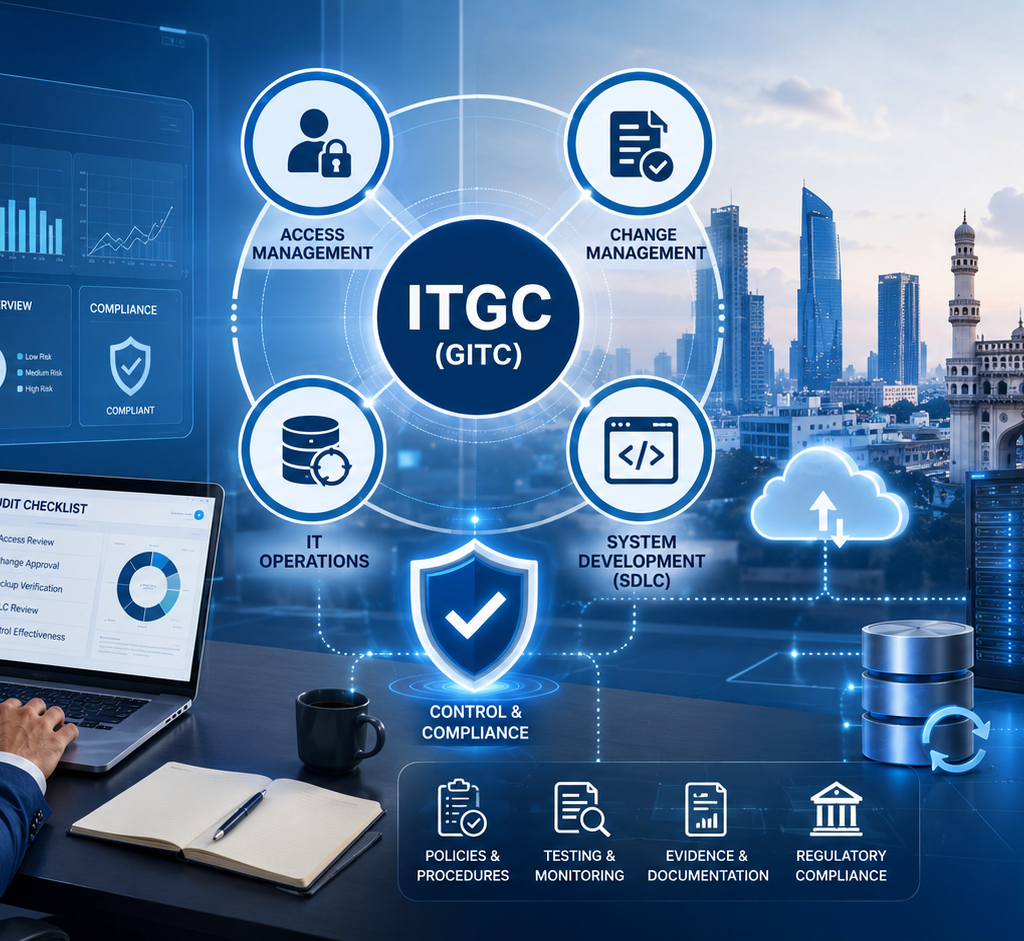
What is ITGC ? ITGC stands for Information Technology General Controls. These are the foundational controls that ensure the proper operation of IT systems and safeguard the integrity of data. ITGCs are essential for regulatory compliance, especially in frameworks like SOX (Sarbanes-Oxley), and are widely used across industries such as banking, healthcare, IT services, and manufacturing. Key Components of ITGC When learning what is ITGC, it’s important to understand its core components. ITGC is generally divided into three main areas: 1. Access Controls Access controls ensure that only authorized individuals can access systems and data. This includes: User account creation and deletion Role-based access Password policies Segregation of duties (SoD) Strong access control prevents unauthorized activities and protects sensitive information. 2. Change Management Change management controls govern how changes are made to systems and applications. This involves: Documenting change requests Testing changes before implementation Approving changes through proper channels Tracking system updates Understanding this aspect helps clarify what is ITGC, as uncontrolled changes can lead to system errors or vulnerabilities. 3. IT Operations Controls These controls ensure that IT systems run smoothly on a daily basis. They include: Job scheduling and monitoring Backup and recovery processes Incident and problem management System performance monitoring Effective IT operations ensure business continuity and minimize downtime. Real-World Example of ITGC To better understand what is ITGC, consider a simple example: Imagine a company’s payroll system. Access Control: Only HR and authorized finance staff can access payroll data Change Management: Any updates to salary calculation logic must be approved and tested IT Operations: Regular backups ensure payroll data is not lost If any of these controls fail, it could result in financial errors or compliance issues. This shows how ITGC directly impacts business operations. Who Uses ITGC? Understanding what is ITGC also involves knowing who works with it. ITGC is used by: IT Auditors Risk and Compliance Professionals Internal Auditors Information Security Teams Finance and SOX Compliance Teams These professionals evaluate IT controls to ensure systems are secure and compliant with regulations. Importance of ITGC in Audits One of the main reasons people ask what is ITGC is because of its importance in audits. During an IT audit, auditors assess whether controls are: Properly designed Effectively implemented Consistently followed If ITGC controls are weak, it can impact financial audits and lead to compliance failures. Strong ITGC controls help organizations: Pass audits smoothly Reduce risk of fraud Ensure accurate financial reporting Career Opportunities in ITGC Now that you understand what is ITGC, you might be wondering about career opportunities in this field. ITGC is a high-demand domain with roles such as: IT Auditor SOX Analyst Risk & Compliance Analyst Internal Auditor IT Control Tester With organizations increasingly focusing on governance and security, professionals with ITGC knowledge are highly valued. Skills Required to Learn ITGC To fully grasp what is ITGC and build a career in this field, you need a mix of technical and analytical skills: Basic understanding of IT systems Knowledge of business processes Analytical thinking Attention to detail Communication skills for reporting The good news is that you don’t need deep technical expertise to get started. With the right training, anyone can learn ITGC from scratch. How to Learn ITGC Effectively If you are serious about understanding what is ITGC and building a career in this field, structured learning is key. A good training program will help you: Understand concepts in a simple way Practice real-time scenarios Learn how to perform control testing Prepare for job interviews Instead of just theoretical knowledge, practical exposure is what makes you job-ready. Why Practical Training Matters Many learners struggle even after understanding what is ITGC because they lack hands-on experience. Practical training helps you: Work on real audit scenarios Understand how controls are tested Gain confidence in interviews Be prepared for real job responsibilities This is why choosing the right training institute plays a crucial role in your learning journey.  Common Challenges in Understanding ITGC When learning what is ITGC, beginners often face challenges such as: Confusion between ITGC and application controls Difficulty understanding audit terminology Lack of real-world examples Limited practical exposure These challenges can be overcome with guided training and structured learning. Future Scope of ITGC The demand for ITGC professionals is growing rapidly as organizations adopt new technologies like cloud computing and automation. Understanding what is ITGC today can open doors to future roles in: Cybersecurity IT Risk Management Governance and Compliance Data Protection As businesses continue to digitize, ITGC will remain a critical function in ensuring secure and reliable systems. Conclusion So, what is ITGC? It is the foundation of IT governance that ensures systems are secure, data is reliable, and processes are controlled. From access management to change control and IT operations, ITGC plays a vital role in every organization. Whether you are a student, fresher, or working professional, learning ITGC can open up exciting career opportunities in IT audit and compliance. Our ITGC course in Hyderabad helps learners understand core concepts with real-time practical exposure. Join our industry-focused ITGC training program to gain hands-on skills and prepare for career opportunities in IT audit and compliance.   With the right combination of conceptual understanding and practical training, you can build a strong career in this growing field.

What is ITGC? Read More »

Infographic showing 8 core IT General Controls categories: Access, Change, Operations, SoD, SDLC, Physical, Vendor, Monitoring.

IT General Controls Audit Checklist 2025 — Implementation Best Practices

Introduction If you work in IT audit, compliance, cyber security, or internal controls, you already know one thing: weak IT General Controls (ITGCs) can instantly break your audit results and create unnecessary risks for the business.That’s why having a clear, practical, and actionable ITGC checklist is essential. In this blog, you’ll get: Let’s get started. What Are IT General Controls (ITGCs)? IT General Controls are foundational IT policies and procedures that ensure the confidentiality, integrity, and availability of data and systems.They support reliable financial reporting, protect business applications, and prevent unauthorized access or changes. ITGCs typically cover: Why Are ITGCs Important? Strong ITGCs help organizations: Without solid ITGCs, even the best applications or financial systems become risky. Core ITGC Categories 1. Access Management Controls for adding, modifying, and removing user access. 2. Change Management Controls for managing changes to systems and applications. 3. IT Operations Includes job scheduling, backups, patching, and system monitoring. 4. Segregation of Duties (SoD) Ensures no single user has excessive privileges that can create risk. 5. SDLC (System Development Life Cycle) Covers development, testing, and deployment of software. 6. Physical & Environmental Security Protects physical infrastructure and data centers. 7. Vendor & Third-Party Controls Monitors risks related to outsourced systems or services. 8. Monitoring & Logging Ensures logs exist and are reviewed regularly. ITGC Audit Checklist (2025 Edition) A. Access Management Controls B. Change Management Controls C. IT Operations & Patch Management D. Segregation of Duties (SoD) E. SDLC Controls F. Physical & Environmental Controls G. Vendor & Third-Party Controls H. Monitoring & Logging Controls Best Practices for ITGC Implementation Step-by-Step ITGC Implementation Roadmap 0–30 Days: Assessment 31–60 Days: Quick Wins 61–90 Days: Automation Quarterly ITGC Interview Questions (Quick Prep) Q1. Why are ITGCs important for SOX compliance?They ensure accurate financial reporting by safeguarding systems involved in financial processes. Q2. What is the difference between access and authorization?Access = ability to log inAuthorization = permissions after logging in Q3. How do you perform an access review?Export users → Review with owner → Remove excess access → Document approvals. Q4. What evidence is needed for change management?Tickets, approvals, test results, deployment logs, rollback plan. Conclusion Implementing strong ITGCs is not just about passing an audit — it helps build a secure, reliable, and well-controlled IT environment. Use this checklist regularly and keep improving your control maturity. If you need templates or help preparing for ITGC/SOX roles, MTJ Job Solutions provides hands-on training and real-time project guidance.

IT General Controls Audit Checklist 2025 — Implementation Best Practices Read More »

Scroll to Top