Uncategorised

Why ITGC Is Important for Every Organization

Why ITGC Is Important for Every Organization

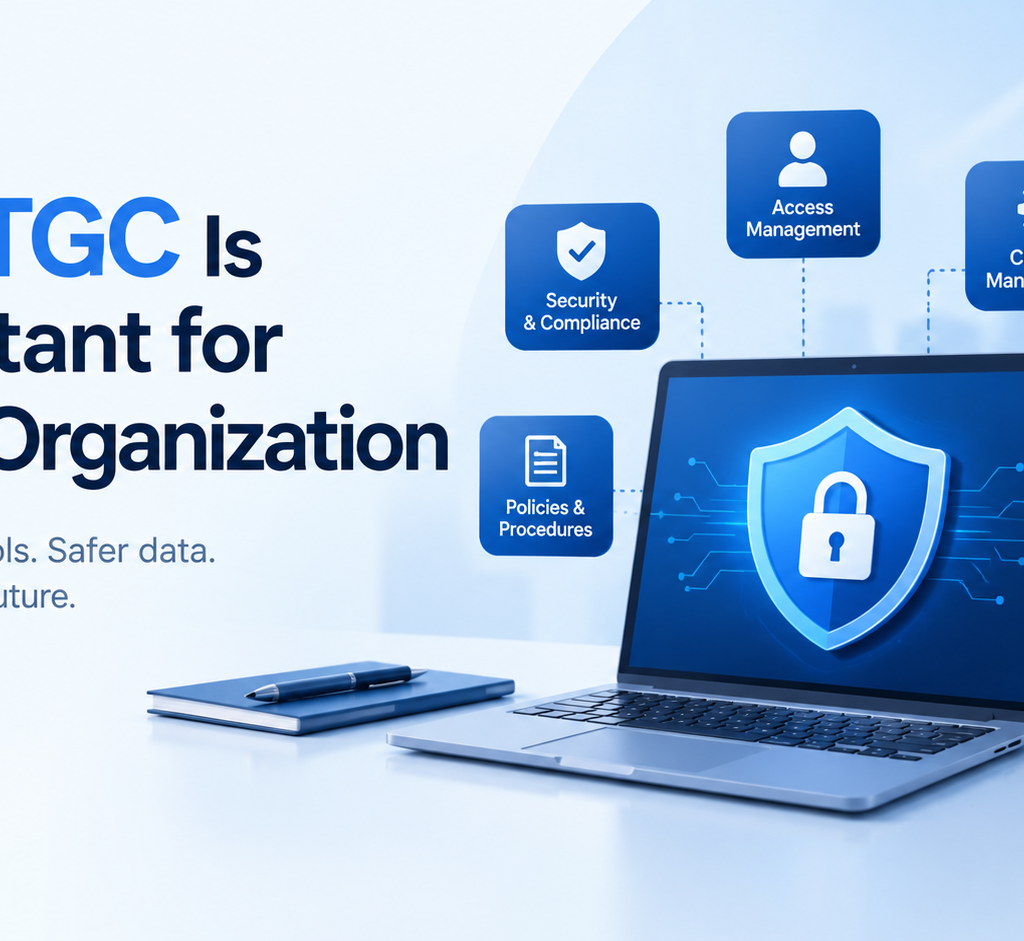
In today’s digital business environment, almost every organization depends on technology to perform daily operations. Companies use applications to manage customer information, financial transactions, employee records, payments, communication, and business processes. While technology makes business faster and more efficient, it also creates risks related to security, access, data accuracy, and system reliability. This is where Information Technology General Controls (ITGC) become important. ITGC refers to the controls, policies, and procedures used to manage and protect an organization’s IT environment. These controls help ensure that technology systems operate properly, information remains secure, and important business processes are supported by reliable IT systems. ITGC is not limited to large multinational companies. Organizations of different sizes and industries can benefit from having appropriate IT controls in place. What Is ITGC? Information Technology General Controls, commonly called ITGC, are controls that support the overall IT environment of an organization. Unlike application-specific controls that focus on individual transactions or business applications, ITGC focuses on the broader technology environment. These controls help create a secure and controlled foundation for applications and business processes. Common areas covered under ITGC include: Access management Change management IT operations Backup and recovery User account management Incident management System development and implementation IT policies and procedures Security monitoring For example, when an employee joins an organization, there should be a process for creating the required user account and providing appropriate access. When the employee leaves, access should be removed or disabled. These activities are examples of access management controls. Why Is ITGC Important? The importance of ITGC has increased as businesses have become more dependent on technology. A weakness in an IT environment can affect data, applications, business operations, and even financial reporting. Here are some important reasons why organizations need ITGC. 1. Protects Sensitive Information Organizations handle large amounts of sensitive information every day. This may include customer information, employee data, financial records, business documents, passwords, and confidential company information. Without appropriate controls, unauthorized individuals may gain access to sensitive systems or information. ITGC helps organizations establish processes for controlling who can access systems and what level of access they should receive. For example, an employee working in HR may need access to employee-related systems but may not need access to financial applications. Appropriate access controls help reduce unnecessary access. 2. Controls User Access Access management is one of the major areas of ITGC. Organizations need to ensure that users receive access based on their job responsibilities. Access should also be reviewed regularly to identify unnecessary or inappropriate permissions. Important access management activities can include: User creation User modification User termination Password management Privileged access management Periodic access reviews Segregation of duties Consider an employee who changes departments. If their previous system access is not removed, they may continue to have permissions that are no longer required. Proper ITGC processes help organizations manage these situations. 3. Reduces Technology-Related Risks Every IT environment has risks. Systems can experience unauthorized changes, incorrect configurations, security incidents, application failures, or data loss. ITGC provides a structured approach to identifying and controlling these risks. For example, change management controls can require changes to be requested, reviewed, tested, approved, and documented before being moved into production. This reduces the possibility of an untested change causing problems in an important business application. 4. Supports Reliable Financial Reporting Technology plays an important role in financial reporting. Organizations often use ERP systems, accounting applications, databases, and other technology platforms to process financial information. If access to these systems is not properly controlled or if unauthorized changes are made, the reliability of financial information can be affected. Strong ITGC can provide supporting evidence that important systems are operating under controlled processes. This is one reason ITGC is commonly associated with frameworks and audits related to financial reporting. 5. Helps During IT Audits Audits require organizations to demonstrate that appropriate controls exist and are operating effectively. During an ITGC audit, auditors may review areas such as: User access Access reviews Terminated user accounts Change requests Change approvals Backup procedures Incident records IT policies System operations Evidence of control performance Organizations with clearly documented processes can make the audit process more structured. Good documentation also helps organizations understand how their controls operate and where improvements may be required. Major Areas of ITGC Although ITGC frameworks can differ between organizations, several control areas are commonly reviewed. Access Management Access management ensures that users have appropriate permissions based on their responsibilities. Controls may cover employee onboarding, role changes, termination, privileged accounts, and periodic access reviews. Change Management Applications and infrastructure are regularly changed to fix problems, introduce new features, or improve performance. Change management controls help ensure that changes are properly requested, tested, reviewed, approved, and implemented. IT Operations IT operations controls focus on the day-to-day functioning of technology systems. This can include job monitoring, system monitoring, incident management, scheduled activities, and operational procedures. Backup and Recovery Organizations need reliable methods for protecting important data. Backup controls help ensure that important information is backed up appropriately and that recovery procedures are available when required. Organizations may also conduct recovery testing to understand whether systems and data can be restored successfully. System Development and Implementation When organizations develop or implement new systems, controls help ensure that development, testing, approval, and deployment activities are appropriately managed. This helps reduce the risks associated with introducing new technology into the production environment. What Happens When ITGC Is Weak? Weak ITGC can create several risks. For example, if terminated employees continue to have access to company systems, there may be an unauthorized access risk. If changes are made directly to production systems without proper testing or approval, system failures or unexpected behavior may occur. Similarly, if backups are not properly monitored or tested, an organization may face difficulties recovering important information after a system failure. Weak documentation can also make it difficult for an organization to demonstrate that controls are operating effectively during an audit. The impact of these weaknesses can vary depending on the organization’s size, systems,

Why ITGC Is Important for Every Organization Read More »
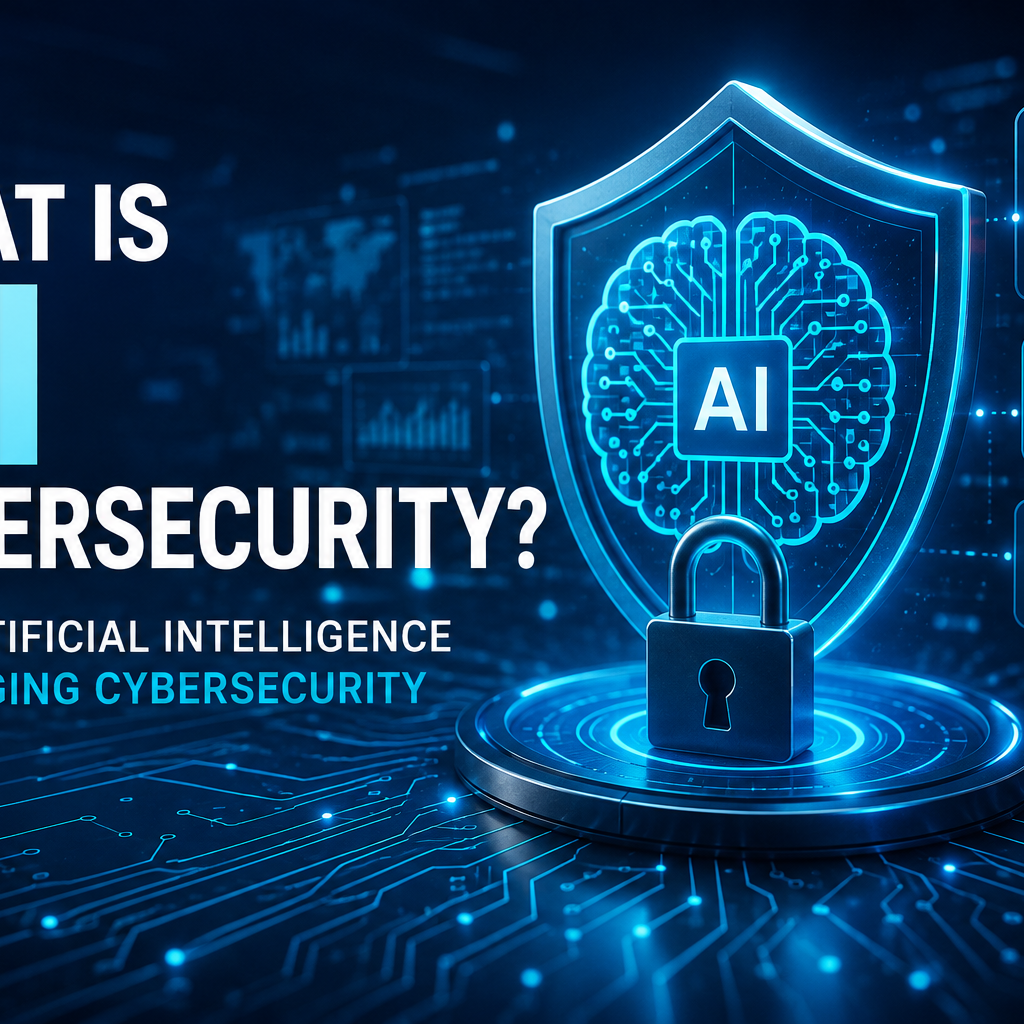
AI Cybersecurity Shield Interface

What Is AI Cybersecurity? How Artificial Intelligence Is Changing Cybersecurity

Imagine this. It’s 2:17 AM. A company’s security team is asleep, but thousands of events are happening across its network. An employee’s account is attempting to log in from an unusual location. A device has suddenly started communicating with an unfamiliar server. Hundreds of emails are being sent to employees, and some contain suspicious links. A few years ago, security teams might have had to investigate many of these events manually. Today, artificial intelligence can help security teams make sense of this activity in seconds. It can recognize unusual behavior, connect seemingly unrelated events, identify suspicious patterns, and help security analysts decide which alerts deserve immediate attention. This is where AI cybersecurity comes into the picture. But AI isn’t only helping defenders. Cybercriminals are also using artificial intelligence to create more convincing phishing messages, automate certain activities, and increase the scale and speed of attacks. So what exactly is AI cybersecurity, and why is it becoming so important? Let’s start from the beginning. What Is AI Cybersecurity? AI cybersecurity is the use of artificial intelligence and machine learning to detect, prevent, analyze, and respond to cybersecurity threats. At the same time, AI cybersecurity also involves protecting AI systems themselves from attacks, manipulation, data exposure, and other security risks. In simple terms: AI used for defense Security of AI Detect suspicious activity Protect AI models Identify malware Secure training data Detect phishing Prevent prompt injection Analyze threats Control AI access Automate security tasks Protect AI applications Prioritize alerts Monitor AI behavior This means AI cybersecurity has two sides of the same coin. Organizations can use AI to defend themselves, while they must also defend their AI systems. How Does AI Cybersecurity Work? Think about a security analyst sitting in front of a dashboard. The dashboard may contain millions of pieces of information: A human cannot realistically examine every event individually. This is where AI can help. AI systems can analyze large amounts of security information and look for patterns. For example, imagine an employee named Sarah. Sarah normally logs in from Bangalore between 9 AM and 6 PM. One morning, the system detects: Login → unusual location → unusual device → unusual time → access to sensitive application Each event might look harmless on its own. But when AI connects the events, the overall behavior may look suspicious. The system can then raise an alert for the security team. This is one of the major advantages of AI-powered cybersecurity: it can help identify relationships between events rather than looking at every event in isolation. Why Is AI Important in Cybersecurity? The cybersecurity landscape is becoming more complicated. Organizations now operate across: Every new technology can create another potential attack surface. At the same time, attackers are becoming more sophisticated. The World Economic Forum’s 2026 cybersecurity research reported that 94% of respondents expect AI to be the most significant driver of change in cybersecurity over the coming year. This explains why organizations are increasingly looking at AI not simply as another technology, but as an important part of their security strategy. How Is AI Used in Cybersecurity? Let’s follow our fictional security team, Alex and Priya, through a normal working day. 1. AI Detects Suspicious Activity Alex arrives at the security operations center and sees hundreds of alerts. Instead of treating every alert equally, an AI-powered system can help identify which events appear most suspicious. It may recognize: The result? Security analysts can focus their attention where it matters most. 2. AI Helps Detect Phishing Priya receives an email that appears to come from the company’s finance department. The email asks her to urgently verify her account. At first glance, everything looks legitimate. AI-powered email security can analyze signals such as: It can then identify characteristics associated with phishing. This is becoming particularly important because AI can also help attackers create more convincing social-engineering messages. 3. AI Helps Detect Malware A suspicious file enters the organization. Traditional security technologies can use known signatures to identify previously seen malware. AI and machine learning can provide another layer of analysis by examining characteristics and behavior associated with potentially malicious files. This can help security teams identify suspicious activity even when the exact threat has not previously been encountered. 4. AI Helps With User Behavior Analysis Imagine an employee who normally downloads a few documents every day. Suddenly, the account downloads thousands of files at 3 AM. That doesn’t automatically mean the employee is malicious. Perhaps there is a legitimate business reason. But it is unusual enough to investigate. AI can help establish behavioral patterns and flag significant deviations from those patterns. 5. AI Helps Security Operations Centers Security operations centers can receive huge numbers of alerts. AI can help with tasks such as: This can reduce the amount of repetitive work security analysts need to perform. 6. AI Helps With Vulnerability Management A company might have thousands of vulnerabilities across its infrastructure. The difficult question isn’t always: “Which vulnerabilities exist?” The more important question is: “Which vulnerabilities should we fix first?” AI can help analyze factors such as: This can help security teams prioritize remediation. What Are the Benefits of AI Cybersecurity? AI can provide several advantages when implemented correctly. Benefit How AI Helps Faster detection Analyzes security events rapidly Automation Handles repetitive security tasks Scalability Processes large volumes of data Better prioritization Helps identify important alerts Pattern recognition Finds unusual relationships Faster response Supports security workflows Continuous monitoring Can analyze activity around the clock The biggest benefits include: However, AI isn’t a magic button. And this is where the story takes a different turn. Can AI Also Create Cybersecurity Risks? Yes. The same technology that helps defenders can also create opportunities for attackers. Imagine an attacker who wants to send phishing emails to 10,000 people. AI can potentially help create personalized and convincing messages at scale. Attackers may also use AI to assist with activities such as: This creates an interesting cybersecurity battle. Defenders are using AI to become faster. Attackers are using AI to become faster

What Is AI Cybersecurity? How Artificial Intelligence Is Changing Cybersecurity Read More »

Itgc Course

Introduction: Why ITGC Skills Matter for IT Audit and Compliance Careers

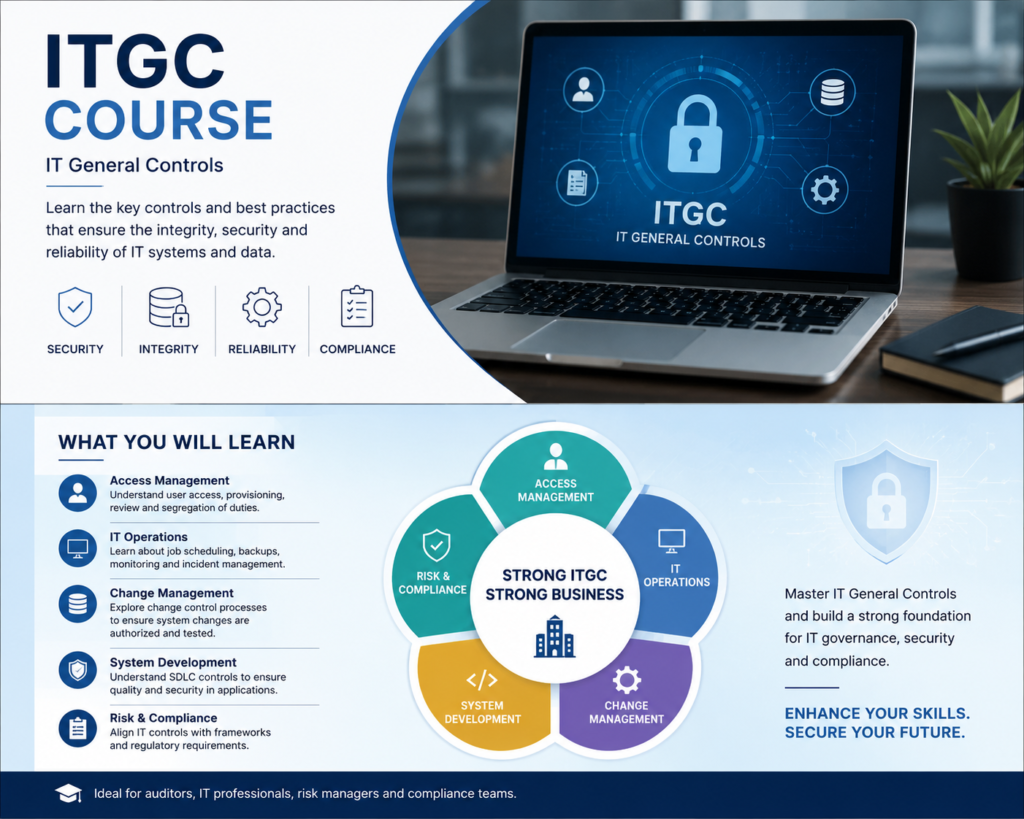
As companies become more dependent on cloud systems, ERP platforms, SaaS applications, cybersecurity tools, payment systems, and automated financial reporting, one question has become critical: Can the organization trust its IT systems, data, access permissions, change processes, and operational controls? That is where ITGC, or Information Technology General Controls, becomes important. For IT audit, risk, compliance, cybersecurity, internal audit, SOX, SOC, and governance professionals, ITGC is one of the most practical skill areas to learn. It connects technology with business risk. It helps auditors verify whether IT systems are secure, reliable, controlled, and compliant. A strong ITGC course in Hyderabad should not only explain definitions. It should train learners to perform real ITGC audits, understand control testing, review evidence, identify gaps, document findings, and communicate audit results clearly. This guide explains what ITGC is, ITGC full form, key ITGC controls, ITGC audit process, career scope, salary potential, course syllabus, and how to choose the best ITGC training in Hyderabad. What Is ITGC? ITGC full form: Information Technology General Controls ITGC refers to the broad controls that help ensure an organization’s IT environment is secure, reliable, available, and properly managed. In simple words: ITGC controls are the basic technology controls that protect systems, data, users, applications, and IT operations across an organization. ITGCs are not limited to one application. They support the entire IT environment. They are important because business processes such as finance, payroll, procurement, customer management, inventory, banking, billing, and reporting often depend on IT systems. SailPoint describes IT general controls as internal policies that govern how an organization’s technology is acquired, architected, deployed, used, and maintained. Key functions include access control, user account creation, data management, infrastructure, applications, and data security. MetricStream explains that IT General Controls form the foundation for operational controls and regulatory compliance, with common components including access controls, change management, backup and recovery, and system operations. Why ITGC Is Important ITGC is important because weak IT controls can affect financial reporting, security, compliance, business continuity, and customer trust. For example: Weak IT Control Possible Risk No access review Ex-employees may still access critical systems Weak password policy Unauthorized users may compromise systems Poor change management Unapproved code changes may break applications No backup testing Data may not be recoverable after failure Incomplete audit logs Incidents may be difficult to investigate Shared admin IDs Accountability becomes weak No segregation of duties One person may initiate and approve risky changes ITGCs are especially important in audits related to: AICPA states that a SOC 2 examination reports on controls at a service organization that are relevant to security, availability, processing integrity, confidentiality, or privacy. ITGC Full Form and Meaning Term Meaning ITGC Information Technology General Controls ITAC Information Technology Application Controls GITC General IT Controls, often used interchangeably with ITGC IT Audit Independent review of IT systems, controls, risks, and governance SOX ITGC IT general controls tested as part of Sarbanes-Oxley compliance SOC ITGC IT controls reviewed in SOC 1 or SOC 2 audit engagements In many job descriptions, you may see terms such as: These terms are closely related. ITGC Audit: What Does It Mean? An ITGC audit is a structured review of IT controls to check whether they are designed properly and operating effectively. An ITGC audit usually answers questions like: ISACA provides IT audit resources, publications, training, and best practices to help professionals improve audit processes and ensure compliance. Why Hyderabad Is a Strong Location for ITGC Training Hyderabad is one of India’s major technology and corporate service hubs. It has a strong presence of IT companies, global capability centers, consulting firms, financial services operations, cybersecurity teams, cloud operations teams, and audit support teams. For learners in Hyderabad, ITGC training can be useful for roles in: Glassdoor’s salary data for Hyderabad reports IT Auditor base pay around ₹8L–₹18L per year, with an average base pay around ₹10L per year, based on data last updated in November 2025. That does not mean every beginner will earn that immediately. Salary depends on experience, certifications, domain knowledge, communication skills, audit exposure, and hands-on tools. But it does show that IT audit is a serious career path, not just a theoretical compliance subject. Who Should Take an ITGC Course in Hyderabad? A well-designed ITGC course is useful for both technical and non-technical professionals. Best Fit Learners Learner Type Why ITGC Helps Commerce graduates Builds a bridge from accounting/audit to IT risk MBA finance students Helps enter risk advisory and compliance roles B.Com / M.Com graduates Useful for audit, SOX, SOC, and compliance careers B.Tech / MCA graduates Adds audit and governance skills to technical knowledge Internal auditors Helps expand from process audit to IT audit Cybersecurity beginners Builds compliance and control-testing foundation CA / CMA / ACCA aspirants Useful for IT audit and financial control testing Working professionals Helps move into GRC, risk, compliance, and audit roles Freshers Good entry point into IT audit and compliance support roles Ideal Job Roles After ITGC Training What Makes the Best ITGC Course in Hyderabad? The best ITGC course in Hyderabad should be practical, audit-oriented, and career-focused. It should not only teach textbook definitions. It should help students understand how real audits are planned, executed, documented, reviewed, and reported. A Strong ITGC Course Should Include Course Feature Why It Matters ITGC fundamentals Helps beginners understand audit language Real control examples Makes concepts practical SOX, SOC, ISO, COBIT awareness Builds framework knowledge Access control testing One of the most common ITGC areas Change management testing Essential for application and infrastructure audits IT operations testing Covers backups, jobs, monitoring, incidents Evidence review Helps learners understand audit documentation Workpaper preparation Required in real audit jobs Risk and control matrix Core audit deliverable Practical assignments Builds confidence Interview preparation Helps learners get hired Resume guidance Converts learning into employability Core ITGC Controls Every Learner Must Know Most ITGC audits focus on a few major control areas. 1. Logical Access Controls Logical access controls ensure that only authorized users can access systems, applications, databases, and

Introduction: Why ITGC Skills Matter for IT Audit and Compliance Careers Read More »

AWS DevOps Engineer

Introduction: Why AWS DevOps Engineer Jobs Are in Demand in 2026

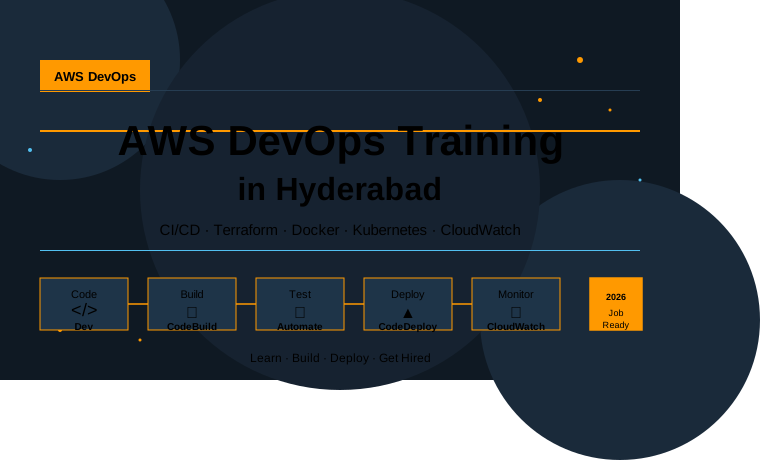
AWS DevOps Engineer jobs sit at the intersection of three high-demand areas: cloud computing, automation, and software delivery. Companies want faster releases, reliable infrastructure, secure pipelines, and systems that scale without constant manual intervention. That is exactly where AWS DevOps engineers add value. In 2026, the role is no longer limited to “deployment support.” Modern AWS DevOps engineers are expected to understand cloud architecture, CI/CD pipelines, Infrastructure as Code, observability, containers, security, cost optimization, incident response, and increasingly AI-assisted engineering workflows. AWS describes the AWS Certified DevOps Engineer Professional credential as validating advanced technical expertise in provisioning, operating, and managing distributed application systems on AWS. The exam focuses on automation, deployment, operations, and reliability across AWS environments. Earning the AWS DevOps Engineer certification is one of the most recognized ways to validate your skills and stand out in a competitive job market. For learners based in cities with strong IT ecosystems, enrolling in structured AWS DevOps training in Hyderabad is one of the most practical ways to gain hands-on experience with these tools before entering the job market. Hyderabad has emerged as one of India’s top tech hiring hubs, with major companies actively recruiting AWS DevOps engineers from training programs that combine cloud fundamentals with real project work. For a software training website, AWS DevOps is a strong career topic because it gives learners a practical route into cloud jobs, platform engineering, site reliability engineering, DevSecOps, and automation-focused roles. What Does an AWS DevOps Engineer Do? Before diving into responsibilities, it helps to understand what DevOps actually means. What is DevOps? DevOps is a set of practices, cultural philosophies, and tools that combines software development (Dev) and IT operations (Ops). It is implemented to shorten the software development lifecycle, automate repetitive tasks, and deliver applications and features at higher velocity and reliability. When DevOps is implemented on AWS, engineers use cloud-native services and automation to eliminate the silos between development and operations teams. An AWS DevOps Engineer designs, builds, automates, deploys, monitors, and improves software delivery systems on Amazon Web Services. They help teams answer questions like: A typical AWS DevOps engineer works with developers, QA engineers, cloud architects, security teams, and operations teams. Common AWS DevOps Engineer Responsibilities Responsibility What It Means in Real Projects CI/CD pipeline creation Building automated pipelines using CodePipeline, GitHub Actions, Jenkins, GitLab CI, or similar tools Build automation Running tests, packaging code, and creating deployable artifacts Deployment automation Deploying applications to EC2, ECS, EKS, Lambda, Elastic Beanstalk, or Kubernetes Infrastructure as Code Creating repeatable AWS infrastructure with CloudFormation, CDK, or Terraform Monitoring and alerting Using CloudWatch, logs, metrics, dashboards, and alarms Incident response Troubleshooting failed deployments, outages, latency, scaling issues, and infrastructure errors Security automation Managing IAM roles, secrets, vulnerability scans, and secure pipeline permissions Container operations Building Docker images, pushing to ECR, running workloads on ECS or EKS Cost optimization Identifying overprovisioned resources, unused infrastructure, and inefficient scaling patterns AWS CodePipeline is a core service in this workflow because it automates the build, test, and deploy phases of a release process whenever code changes occur. AWS DevOps Engineer Salary in 2026 AWS DevOps salaries vary by country, city, experience, company type, cloud depth, certification, and whether the role includes Kubernetes, platform engineering, security, or SRE responsibilities. Salary data also varies by source because job titles are not always standardized. Some companies use titles such as: 2026 AWS DevOps Engineer Salary: United States Glassdoor’s April 2026 data reports an average salary of about $139,925 per year for AWS/DevOps Engineers in the United States, with a typical range between about $114,729 and $172,433 annually. Robert Half’s 2026 salary guide lists DevOps Engineer salary ranges from approximately $118,000 to $173,750, which aligns closely with the broader market range for experienced DevOps roles. PayScale reports the average U.S. salary for a Development Operations Engineer at about $114,661 in 2026. US Salary Interpretation Level Typical 2026 Range What Employers Usually Expect Entry-level / Junior $80,000–$105,000 Linux, Git, AWS basics, CI/CD exposure, scripting Mid-level $105,000–$145,000 Production AWS experience, IaC, pipelines, monitoring Senior $145,000–$180,000+ Architecture, Kubernetes, reliability, security, mentoring Specialist / Lead $180,000+ Platform engineering, multi-account AWS, large-scale systems, SRE leadership These ranges are practical approximations based on market data. Actual compensation can be higher in major tech hubs, finance, SaaS, AI infrastructure companies, and senior platform engineering roles. 2026 AWS DevOps Engineer Salary: India Glassdoor’s April 2026 India data reports the average AWS/DevOps Engineer salary at around ₹7,42,500 per year, with a typical range between approximately ₹4,96,750 and ₹13,87,500 annually. Another Glassdoor India salary result for AWS/DevOps Engineer reports an average of about ₹6,82,500 per year, with top earners reaching approximately ₹40,00,000 in some reported cases. PayScale reports the average salary for a Development Operations Engineer in India at about ₹996,275 in 2026, with reported pay ranging from about ₹404,000 to ₹3,000,000 depending on experience and profile. For learners pursuing AWS DevOps training in Hyderabad, the city’s concentration of product companies, IT services firms, and cloud-first startups means strong local hiring demand across all experience levels, from freshers to senior engineers. India Salary Interpretation Level Typical 2026 Range What Employers Usually Expect Fresher / Entry-level ₹3.5 LPA–₹6 LPA Linux, AWS fundamentals, Git, basic CI/CD Junior AWS DevOps ₹5 LPA–₹9 LPA EC2, S3, IAM, CodePipeline, Docker basics Mid-level AWS DevOps ₹9 LPA–₹18 LPA Terraform/CloudFormation, Kubernetes/ECS, monitoring Senior AWS DevOps ₹18 LPA–₹35 LPA+ Architecture, DevSecOps, multi-account AWS, SRE Lead / Platform Engineer ₹30 LPA+ Platform strategy, automation frameworks, scaling, governance Important Note on Salary Data Salary portals rely on user-submitted data, job listings, and market estimates. Treat them as guidance, not guarantees. The best way to earn more is to build demonstrable skills in real AWS projects, CI/CD, Infrastructure as Code, containers, monitoring, security, and cloud architecture. AWS DevOps Engineer Job Market in 2026 AWS DevOps hiring remains strong because companies need engineers who can make cloud delivery faster, safer, and more reliable. The U.S. Bureau of Labor Statistics reports that the broader computer and information technology occupational group had

Introduction: Why AWS DevOps Engineer Jobs Are in Demand in 2026 Read More »

Salesforce Careers 2026 — Roadmap, Roles, Skills, Salary & How to Get Started

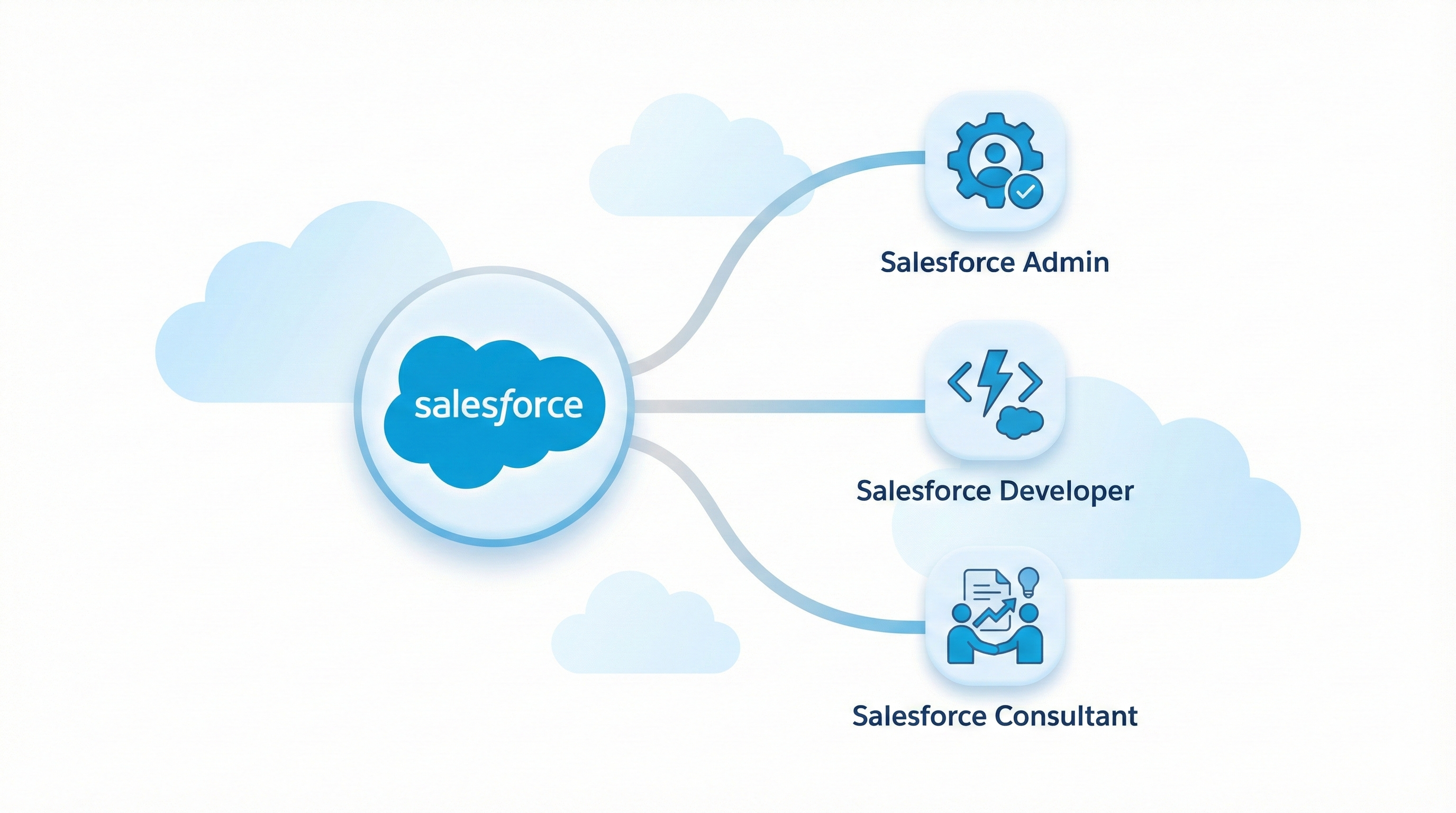
Introduction Salesforce is one of the most popular and powerful CRM platforms in the world. Many students and working professionals are planning to build their careers in Salesforce, but they often feel confused about where to start, which roles to choose, and how to get a job. If you are also thinking about Salesforce careers, you are in the right place. In this blog, you will learn everything about Salesforce careers in 2025, including the career roadmap, job roles, required skills, certifications, salary details, and how beginners can start step by step. What is Salesforce? Salesforce is a cloud-based Customer Relationship Management (CRM) platform that helps companies manage sales, marketing, customer service, and business relationships in one place. Salesforce is widely used by: It is trusted by thousands of organizations worldwide. Why Choose a Career in Salesforce? Salesforce careers are in high demand because: Salesforce professionals are needed in IT, banking, healthcare, retail, and e-commerce sectors. Salesforce Career Roadmap (Beginner to Expert) Step 1: Learn Salesforce Basics Step 2: Choose Your Career Path Based on your interest, choose one: Step 3: Learn Salesforce Trailhead Trailhead is Salesforce’s free learning platform. Step 4: Hands-on Practice Step 5: Certification Preparation Salesforce Career Roles Salesforce Administrator Salesforce Developer Salesforce Business Analyst Salesforce Consultant Salesforce Architect Skills Required for Salesforce Careers (2025) Technical Skills Non-Technical Skills Salesforce Certifications (Overview) Popular Salesforce certifications include: Beginners should start with Salesforce Certified Administrator. Salesforce Salary in India (2025) Experience Salary Range Fresher ₹4L – ₹7L 1–3 years ₹7L – ₹12L 3–5 years ₹12L – ₹20L 5+ years ₹20L – ₹35L+ Globally, Salesforce professionals earn $85,000 – $150,000+ per year. Salesforce Job Opportunities Salesforce professionals are hired as: Top hiring industries: Salesforce Interview Questions (Simple Answers) Q1. What is Salesforce? A cloud-based CRM platform used to manage customer relationships. Q2. What is an Object in Salesforce? A database table that stores records. Q3. What is Trailhead? Salesforce’s free online learning platform. Q4. What is Apex? A programming language used in Salesforce. Q5. What is Lightning? The modern UI framework of Salesforce. How to Start a Salesforce Career as a Fresher Consistency and practice are the keys to success. Conclusion Salesforce careers offer strong growth, good salaries, and global opportunities. With the right learning path, certifications, and hands-on practice, beginners can successfully enter this field in 2025. If you are looking for structured training, real-time projects, and placement support, MTJ Job Solutions can help you build a successful Salesforce career.

Salesforce Careers 2026 — Roadmap, Roles, Skills, Salary & How to Get Started Read More »

Scroll to Top