
ITGC Trends

Everything You Need to Know About ITGC and GITC

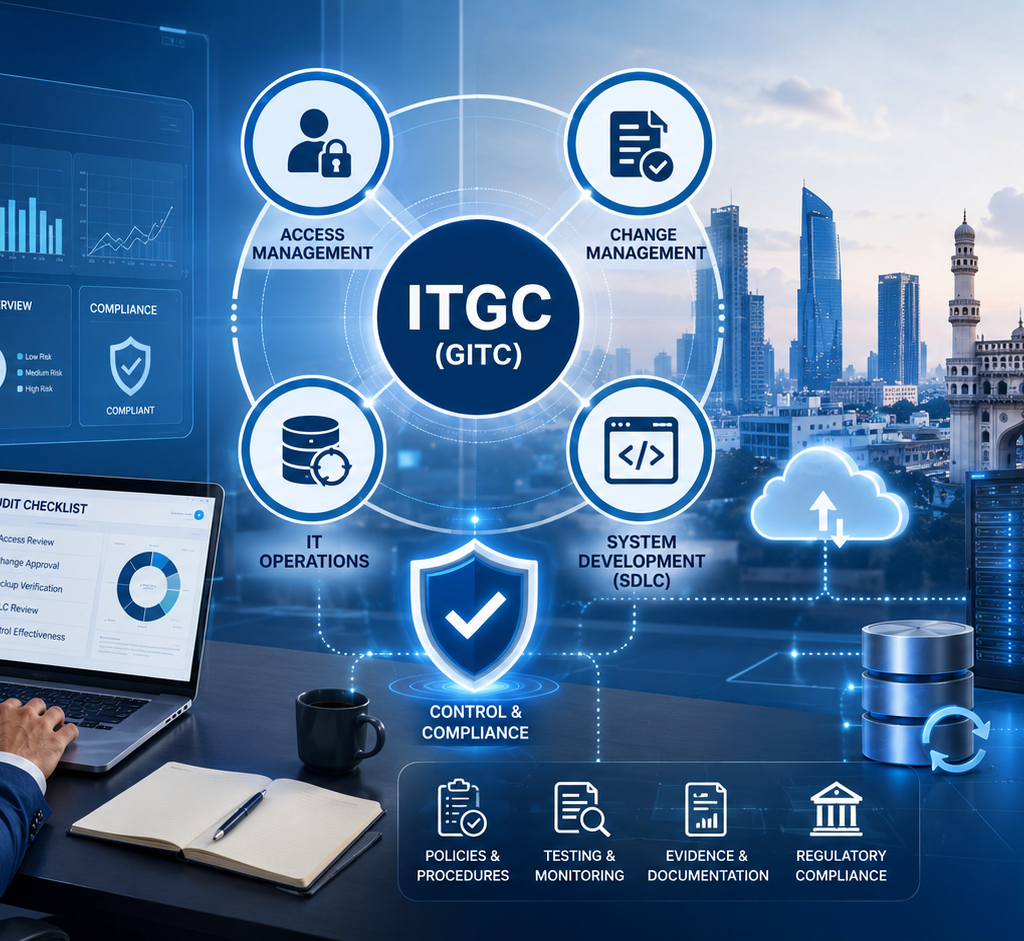
Priya was three months out of her BCom degree, scrolling job listings from a coffee shop in Madhapur, when she saw it: “IT Audit Analyst – ITGC – Freshers Welcome.” She’d never heard the word before. It sounded technical, maybe even coding-related, and she almost scrolled past. A week later, a friend who’d just joined a Hyderabad-based GCC (global capability centre) as an IT Audit intern told her something that changed her mind: “It’s not coding. It’s basically common sense, written down as a checklist. And every big company needs people who can do it.” That checklist is ITGC – Information Technology General Controls. If you’ve also seen the term GITC (General IT Controls, or sometimes General Information Technology Controls) in a job posting and wondered if it’s something different, here’s the short answer: it isn’t. ITGC and GITC describe the exact same set of foundational IT controls; different companies and auditors simply prefer one label over the other. What Exactly Is ITGC, and Why Does Everyone Also Call It GITC? Think of ITGC as the ground rules for how a company’s entire technology environment is run – not any one piece of software, but everything underneath it: who can log into which system, how changes get approved before they go live, how data gets backed up, and how new applications get built and tested. Application-level controls, by contrast, are specific to one piece of software, like a rule inside SAP that stops an invoice from being approved twice. ITGC is the umbrella; application controls sit underneath it. If the umbrella has holes, it doesn’t matter how well-designed the controls under it are – they can be bypassed. This is exactly why ITGC (or GITC) is a phrase you’ll run into constantly if you’re studying for internal audit exams like CIA Part 2, or working anywhere near financial reporting, because a weak ITGC environment can undermine an entire audit. The Four Areas You’ll Actually Test as an Auditor In real audit work, ITGC breaks down into four practical buckets. None of them require you to write a line of code – they require you to look at a process and ask whether the right people can do the right things, and whether there’s evidence of it. Here’s what each one actually means in plain language, and the kind of question an auditor asks to test it: Control Area What It Covers Auditor’s Test Question Access Management Who can log into systems, view or edit data, and how permissions are granted or removed If an employee leaves today, is their access removed within 24 hours? Change Management How updates to systems get approved, tested, and deployed Was this change to the payroll system approved and tested before going live? IT Operations Backups, recovery, job scheduling, and incident handling If the server crashed tonight, could we restore last night’s data by morning? System Development (SDLC) How new applications and systems are built, tested, and rolled out Was this new finance module tested by someone other than the developer before go-live? Notice a pattern? Every single question above is really just “who can do this, and can we prove it was done properly?” That’s the entire mental model behind ITGC. Once that clicks, the rest of the subject stops feeling like jargon and starts feeling like common sense with a checklist attached. Why This “Boring” Topic Became a Hot Hyderabad Career Here’s the part that surprises most freshers: ITGC isn’t a niche corner of IT. It’s a requirement. Public companies under U.S. law (SOX Section 404) must prove their IT controls over financial reporting are effective, and weak ITGC can trigger a formal “material weakness” finding – the kind of thing that makes headlines and costs jobs. Beyond SOX, frameworks like SOC 1, SOC 2, ISO 27001, and COBIT all lean on the same foundation of general IT controls. Hyderabad has turned into one of India’s biggest hubs for exactly this kind of work, largely because of the Global Capability Centre (GCC) boom – the in-house teams that MNCs set up in India to run finance, audit, and technology operations for their global parent companies. These GCCs need people who can test and document controls locally, on behalf of the parent company’s global audit, which is precisely the ITGC skill set. Search any job board today and you’ll find IT Audit Analyst, Internal Audit, and ITGC-and-SOX-testing openings posted out of Hyderabad on a near-daily basis, alongside similar demand in Bengaluru and Mumbai. For a fresher, that means the skill you’re learning isn’t theoretical – it’s actively being hired for, right now, close to home, and often without requiring you to relocate to a different city first. How Much Can You Actually Earn With ITGC Skills? Money is usually the second question after “what does this even mean,” so let’s address it directly. Industry salary data (Payscale, Glassdoor, and related sources, 2026) shows a fairly clear progression for IT audit and ITGC professionals in India: (Illustrative composite based on Payscale, Glassdoor, and industry salary data, 2026; actual pay varies by company and city.) A fresher with 0-2 years of experience can expect to start in the ₹5-6 lakh range, moving toward the national average for IT auditors of roughly ₹8.8 lakh as they gain 2-4 years of hands-on testing experience. Auditors who move into senior or consultant-level roles – especially in metro hubs – often land in the ₹12-15 lakh range, and audit managers can cross ₹20 lakh. None of these numbers are guaranteed, and they’ll vary by company and city, but the direction is consistent: this is a career that rewards a few years of real experience quickly. Do You Need a Coding or Finance Background to Learn ITGC? No, and this is the detail that surprises most people. ITGC work is about evaluating whether a control exists and works as intended, not about writing software or crunching balance sheets. You don’t need to be a programmer, and you don’t need to

Everything You Need to Know About ITGC and GITC Read More »
itgc course

Top ITGC Trends for 2026: A Simple Guide for Future IT Auditors

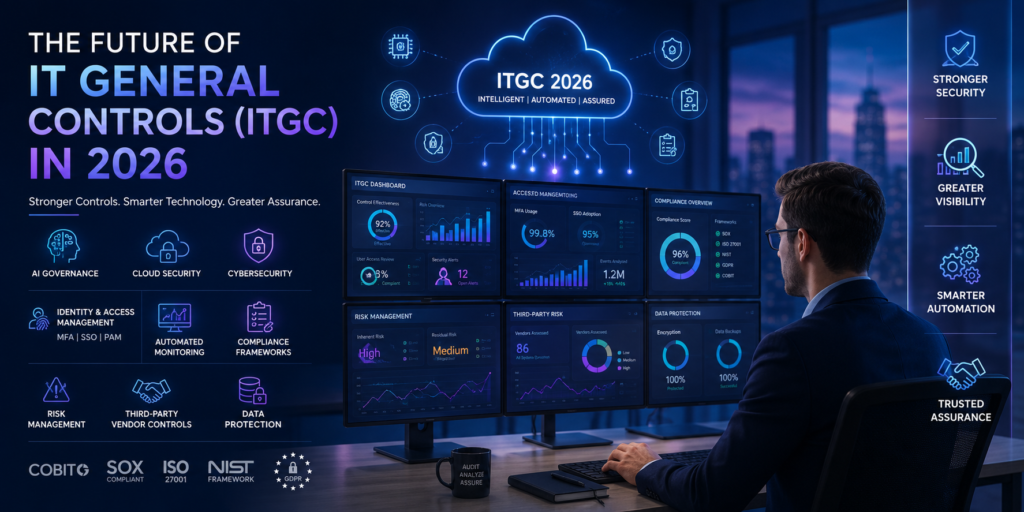
IT Technology is rapidly evolving. Only a few years ago, many companies were focused solely on the basics of system access controls and cybersecurity. Now, businesses employ a plethora of tools such as cloud applications, AI, automation, and tools developed for flexible work environments. These tools have shifted the business world once again, making IT General Controls (ITGC) more imperative. In the age of rapidly evolving technology, understanding the changes and patterns in ITGC will give you a competitive advantage in your desired career in IT audit, risk management, compliance, or cybersecurity. This blog will present the top trends in ITGC for 2026 in an informal and easy-to-read style. To Start Ravi is a recent commerce graduate and new employee at a large multinational company. His first few days on the job were overwhelming and filled with new jargon like ITGC, SOX compliance, access management, and change management. One of his managers said at the end of the day: “Imagine how a building would be without a foundation. It would be a huge risk for everyone. The same is for a company with poor IT controls. Everything from your systems, company data, and even financial reporting will be at a huge risk.” That one analogy gave Ravi the push he needed to start his research on ITGC and find that there is a global investment in IT controls and compliance. Now, what are the main trends of ITGC for 2026? 1. The Governance of AI Will Be Incorporated into ITGC AI is now ubiquitous. Companies use AI in customer service, financial analysis, coding, and even to make business decisions. However, AI has new challenges like: In 2026, it is expected ITGC teams will focus more on AI controls, and auditors will check if companies implement governance to manage AI. Corporations will focus on controls for: All of the above will lead to the creation of new jobs for IT auditors and compliance specialists. 2. Cloud Security Controls Are Increasing More companies are moving their operations from on-premises data centers to the cloud, such as AWS, Azure, and Google Cloud. Cloud technology can lead to greater efficiency, but they come with new problems. ITGC teams focus on: More and more companies are now “cloud-first,” and in 2026, the cloud market will still require the most ITGC focus. Those who know both elements will have significant job market advantage. 3. Automatic Monitoring Replaces Manual Control Checks Before, controls were checked regularly, but the activities to do so were very resource intensive. Now, tools can allow controls to be checked automatically. For example: Automatic monitoring can help identify controls issues proactively. By 2026, most organizations will adopt monitoring technology for control automation, making ITGC controls faster and more accurate. 4. Identity and Access Management Becomes Stronger One crucial area of ITGC is user access management. Organizations need to make sure: With remote work being the norm, more focus has been put on access management. Organizations utilize: Due to the increase in cyber threats, access control is a key focus in ITGC for 2026. 5. Cybersecurity and ITGC Collaborate Historically, cybersecurity and ITGC operated in silos. Currently, the focus is on the systems and data protection which is the ultimate end goal of both functions. Therefore, the following has been observed: The outcome of this systems convergence is improved resilience of the organization and governance. Why More People Are Training In ITGC The need for skilled ITGC professionals is increasing. Organizations are seeking individuals that are able to do: This increase in demand for skilled workers has led more graduates and employees to choose these specializations. In case you are considering a career in ITGC, enrolling in an ITGC training in Hyderabad is a good option. This type of training allows entry-level employees to understand practical topics, like access management, change management, backup controls, and audit testing. Learning by doing is the best way to simplify the understanding and application of complex topics. 6. Compliance Requirements Become More Burdensome Increased legislative and regulatory data protection and information security requirements mean organizations now need to show they have appropriate protective measures. The majority of requirements will concern: In 2026, auditors will focus more on assessing whether organizations have met these requirements. Well-defined ITGC frameworks allow organizations to achieve compliance and limit the risks to the business. 7. Increasing Focus on Managing Third-Party Risk Many organizations depend on third parties. Those third parties may provide: If those third parties have a security incident, the organization can be impacted. For this reason, ITGC teams are focusing more on assessing: The management of third-party risk will continue to be one of the most rapidly expanding service lines in IT audit. 8. ITGC Testing Becomes More Automated Manual testing of ITGCs is a repetitive, resource-draining activity. Many organizations are investing in technology to: The focus of IT auditors will continue to shift from testing controls towards providing more strategic advice. Building a Career in ITGC in 2026 Let us return to Ravi’s story. After several months of learning about ITGC, Ravi knew this was the right career path. Ravi observed that the following roles were available in the job market: To develop his skills, Ravi joined an ITGC course in Hyderabad. He gained knowledge on practical audit scenarios, control testing, compliance, and risk assessment. It took Ravi a year to gain the needed confidence to complete ITGC reviews and work on audit assignments. His story proves that dedication to practice and a desire to learn will always lead to opportunities and a thriving career. Skills Needed for Future ITGC Professionals Aiming for success in 2026 and beyond, individuals are advised to learn: Technical Knowledge Understanding of operating systems, databases, and the cloud, as well as foundational cybersecurity and audit knowledge. Control Testing, Risk Assessment Knowledge on how to collect and document audit evidence. Speaking and Writing Skills These will be useful, as IT auditors communicate with both the technical and corporate sides of the business, as well as

Top ITGC Trends for 2026: A Simple Guide for Future IT Auditors Read More »

Scroll to Top