
IT general controls

Everything You Need to Know About ITGC and GITC

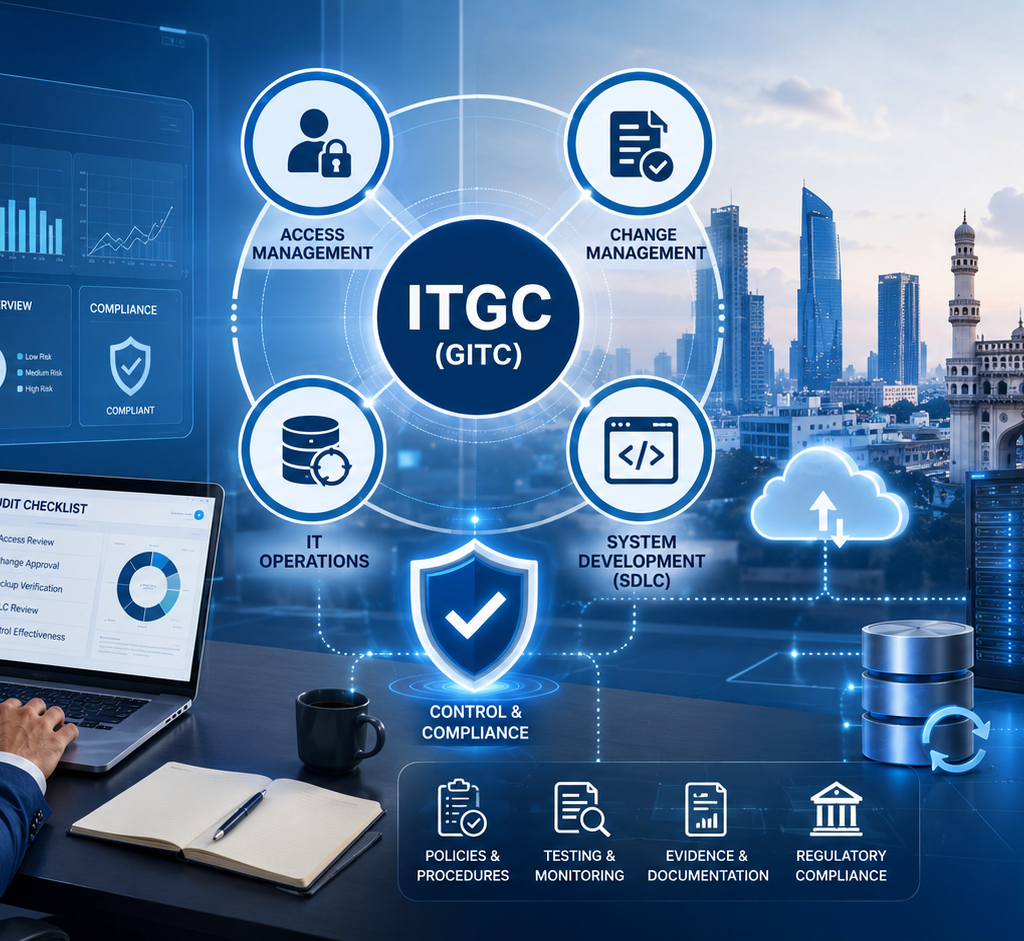
Priya was three months out of her BCom degree, scrolling job listings from a coffee shop in Madhapur, when she saw it: “IT Audit Analyst – ITGC – Freshers Welcome.” She’d never heard the word before. It sounded technical, maybe even coding-related, and she almost scrolled past. A week later, a friend who’d just joined a Hyderabad-based GCC (global capability centre) as an IT Audit intern told her something that changed her mind: “It’s not coding. It’s basically common sense, written down as a checklist. And every big company needs people who can do it.” That checklist is ITGC – Information Technology General Controls. If you’ve also seen the term GITC (General IT Controls, or sometimes General Information Technology Controls) in a job posting and wondered if it’s something different, here’s the short answer: it isn’t. ITGC and GITC describe the exact same set of foundational IT controls; different companies and auditors simply prefer one label over the other. What Exactly Is ITGC, and Why Does Everyone Also Call It GITC? Think of ITGC as the ground rules for how a company’s entire technology environment is run – not any one piece of software, but everything underneath it: who can log into which system, how changes get approved before they go live, how data gets backed up, and how new applications get built and tested. Application-level controls, by contrast, are specific to one piece of software, like a rule inside SAP that stops an invoice from being approved twice. ITGC is the umbrella; application controls sit underneath it. If the umbrella has holes, it doesn’t matter how well-designed the controls under it are – they can be bypassed. This is exactly why ITGC (or GITC) is a phrase you’ll run into constantly if you’re studying for internal audit exams like CIA Part 2, or working anywhere near financial reporting, because a weak ITGC environment can undermine an entire audit. The Four Areas You’ll Actually Test as an Auditor In real audit work, ITGC breaks down into four practical buckets. None of them require you to write a line of code – they require you to look at a process and ask whether the right people can do the right things, and whether there’s evidence of it. Here’s what each one actually means in plain language, and the kind of question an auditor asks to test it: Control Area What It Covers Auditor’s Test Question Access Management Who can log into systems, view or edit data, and how permissions are granted or removed If an employee leaves today, is their access removed within 24 hours? Change Management How updates to systems get approved, tested, and deployed Was this change to the payroll system approved and tested before going live? IT Operations Backups, recovery, job scheduling, and incident handling If the server crashed tonight, could we restore last night’s data by morning? System Development (SDLC) How new applications and systems are built, tested, and rolled out Was this new finance module tested by someone other than the developer before go-live? Notice a pattern? Every single question above is really just “who can do this, and can we prove it was done properly?” That’s the entire mental model behind ITGC. Once that clicks, the rest of the subject stops feeling like jargon and starts feeling like common sense with a checklist attached. Why This “Boring” Topic Became a Hot Hyderabad Career Here’s the part that surprises most freshers: ITGC isn’t a niche corner of IT. It’s a requirement. Public companies under U.S. law (SOX Section 404) must prove their IT controls over financial reporting are effective, and weak ITGC can trigger a formal “material weakness” finding – the kind of thing that makes headlines and costs jobs. Beyond SOX, frameworks like SOC 1, SOC 2, ISO 27001, and COBIT all lean on the same foundation of general IT controls. Hyderabad has turned into one of India’s biggest hubs for exactly this kind of work, largely because of the Global Capability Centre (GCC) boom – the in-house teams that MNCs set up in India to run finance, audit, and technology operations for their global parent companies. These GCCs need people who can test and document controls locally, on behalf of the parent company’s global audit, which is precisely the ITGC skill set. Search any job board today and you’ll find IT Audit Analyst, Internal Audit, and ITGC-and-SOX-testing openings posted out of Hyderabad on a near-daily basis, alongside similar demand in Bengaluru and Mumbai. For a fresher, that means the skill you’re learning isn’t theoretical – it’s actively being hired for, right now, close to home, and often without requiring you to relocate to a different city first. How Much Can You Actually Earn With ITGC Skills? Money is usually the second question after “what does this even mean,” so let’s address it directly. Industry salary data (Payscale, Glassdoor, and related sources, 2026) shows a fairly clear progression for IT audit and ITGC professionals in India: (Illustrative composite based on Payscale, Glassdoor, and industry salary data, 2026; actual pay varies by company and city.) A fresher with 0-2 years of experience can expect to start in the ₹5-6 lakh range, moving toward the national average for IT auditors of roughly ₹8.8 lakh as they gain 2-4 years of hands-on testing experience. Auditors who move into senior or consultant-level roles – especially in metro hubs – often land in the ₹12-15 lakh range, and audit managers can cross ₹20 lakh. None of these numbers are guaranteed, and they’ll vary by company and city, but the direction is consistent: this is a career that rewards a few years of real experience quickly. Do You Need a Coding or Finance Background to Learn ITGC? No, and this is the detail that surprises most people. ITGC work is about evaluating whether a control exists and works as intended, not about writing software or crunching balance sheets. You don’t need to be a programmer, and you don’t need to

Everything You Need to Know About ITGC and GITC Read More »
IT general controls

Top 5 IT General Controls Every Auditor Should Know

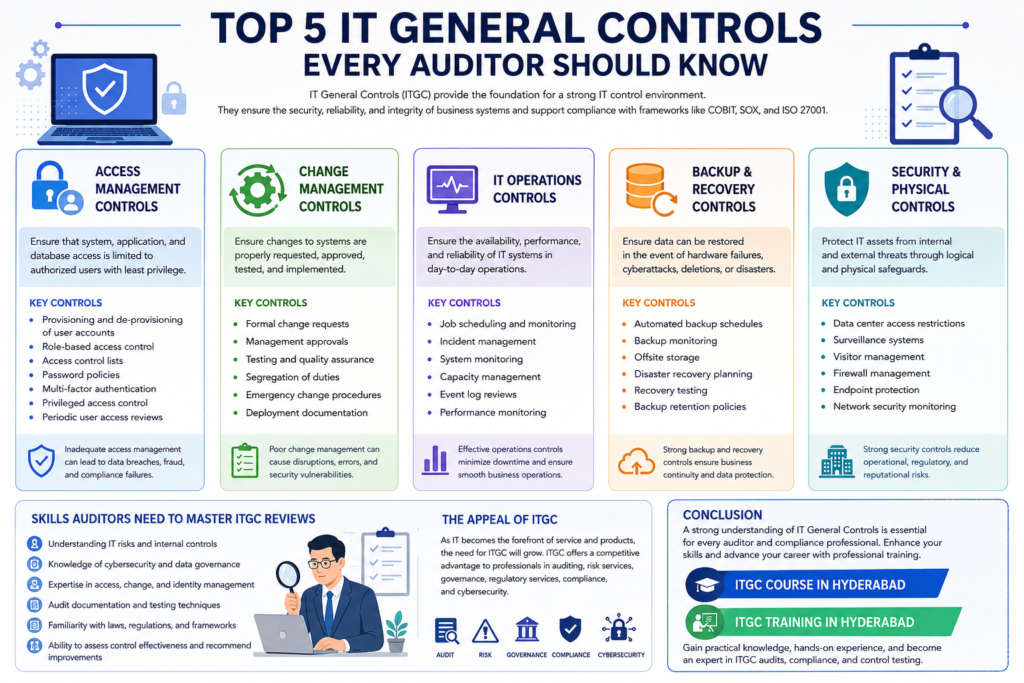
Businesses rely so much on information systems that auditors need to realize just how essential IT General Controls (ITGC) are. They understand the security, reliability, and integrity of business systems. IT General Controls (ITGC) provide the baseline, the building blocks of a business’s IT control environment. They help the business system’s data and processes from the risks of unauthorized access, failures and fraud. Strong ITGC help a business meet compliance and effective control objectives according to the frameworks of COBIT, SOX, and ISO 27001. For those that want to be IT auditors, internal auditors, compliance and/or risk management professionals, understanding ITGC is important. This article discusses the top five IT General Controls that every IT auditor should understand. What are IT General Controls? IT General Controls are the procedures and policies that focus on the confidentiality, accuracy, and availability of information control systems. They can be found in any IT environment in a large business and help application controls, business process controls, and organizational process IT systems. They include access controls, system operation controls, and controls for system backups and security. Poor ITGCs expose the business to operational disruptions, data loss, legal disputes, and false financial statements. Auditors evaluate the ITGC to determine the integrity of business IT. Why IT General Controls Matter in Auditing ITGCs have been called the essentials of IT governance and compliance. Where basic controls are lacking, auditors are likely to have little reliance on the automated or application-layer controls. For instance, if an unauthorized person is able to access a production system or make changes to it, the veracity of financial and operational data is in serious jeopardy. For the ITGCs, auditors consider: There are five critical IT General Controls all auditors should know. The first is Access Management Controls. 1. Access Management Controls Access Management is widely accepted as the most essential of all ITGC domain areas. These controls are focused on ensuring system, application, and database access is limited to individuals who have been authorized to access them. Access Management Controls are built around the concept of Least Privilege, where users are afforded only those permissions that are required in order for them to perform their job functions. Key Access Management Controls Access Management in ITGC audits is highly focused. This is because inadequate access management controls are frequently a cause of data breaches, system fraud, and IT compliance failures. 2. Change Management Controls Companies make changes to applications, infrastructure, and databases. This can be infrastructure / application / database changes. Change management controls document necessary steps like proper requests and approvals, testing changes, and implementation. Change management controls lack the integrity of management if poorly requested and tested changes can be made in production in a disruptive, incomplete, and insecure (for example, a data breach) manner. Key Change Management Controls Audit Procedures Audit may involve: Routine Audit Findings Change management controls lack integrity if controls are incomplete, for example if necessary change controls are not documented. Maintaining systems integrity and operational risks is the purpose for a comprehensive change management program. Change management is a crucial pillar of IT General Controls. 3. IT Operations Controls IT operations controls are concerned with the management and monitoring of IT systems in the operational phase. Controls assure that systems and processes operate without interruptions. Availability of IT operations is critical to the objectives of the organization. Key IT Operations Controls Audit Procedures Auditors may review: Common Audit Findings Four strong IT operations backup and recovery controls offer assurance that business disruption due to unexpected operational issues will be minimized. 4. Backup and Recovery Controls Backup and recovery controls protect one of the most critical recovery resource and asset that any organization possesses: its data. Recovery controls assist in the restoration of data in the event of hardware failures, cyberattacks, deletions, and disasters. These controls also help ensure business recovery is possible after a disruption. Organizations with inadequate backup procedures can incur significant loss of business and financial resources. Key Backup and Recovery Controls Audit Procedures Auditors review: Common Audit Findings Evidence of recovery testing is more critical to auditors than backup procedures. Organizations need to test their recovery procedures to ensure the data and systems can be restored in a timely manner. 5. Security & Physical Controls Security controls aim to keep IT assets safe from threats both inside the organization and externally. Both logical security measures and physical safeguards are included to stop access to facilities and infrastructures. Controls for both physical and logical security are important to the framework of ITGC. Key Security & Physical Controls Audit Procedures Auditors review: Common Audit Findings The lack of strong security controls puts organizations at operational, regulatory, and reputational risks. The management of security controls keeps systems and information safe, unaltered, and accessible. Skills Auditors Need to Master ITGC Reviews To perform the ITGC review competently, professionals will need to master IT risks, internal controls, the basics of cybersecurity, and the documentation of audits. Practical knowledge of laws and data governance, as well as the management of identities, access, and changes, will also be necessary. The ability of auditors to assess the effectiveness of controls and suggest improvements is greatly enhanced by practical knowledge of audit testing. The Appeal of ITGC As IT becomes the forefront of service and products, the need for ITGC will grow. ITGC offers a competitive advantage to professionals in auditing, risk services, governance, regulatory services, compliance, and cybersecurity. Hyderabad ITGC trainings can help you understand access management, change management, IT operations, and audit methods. If you aim to gain more experience, focusing on ITGC audits and compliance in Hyderabad can also help you practice more through audits, compliance methods, and control testing. Conclusion IT General Controls (ITGC) are the foundation of a secure, reliable, and compliant IT environment. From access management and change management to IT operations, backup and recovery, and security controls, these core areas help organizations protect critical systems and data while supporting business objectives. For auditors and

Top 5 IT General Controls Every Auditor Should Know Read More »

Scroll to Top