
Top 5 IT General Controls Every Auditor Should Know
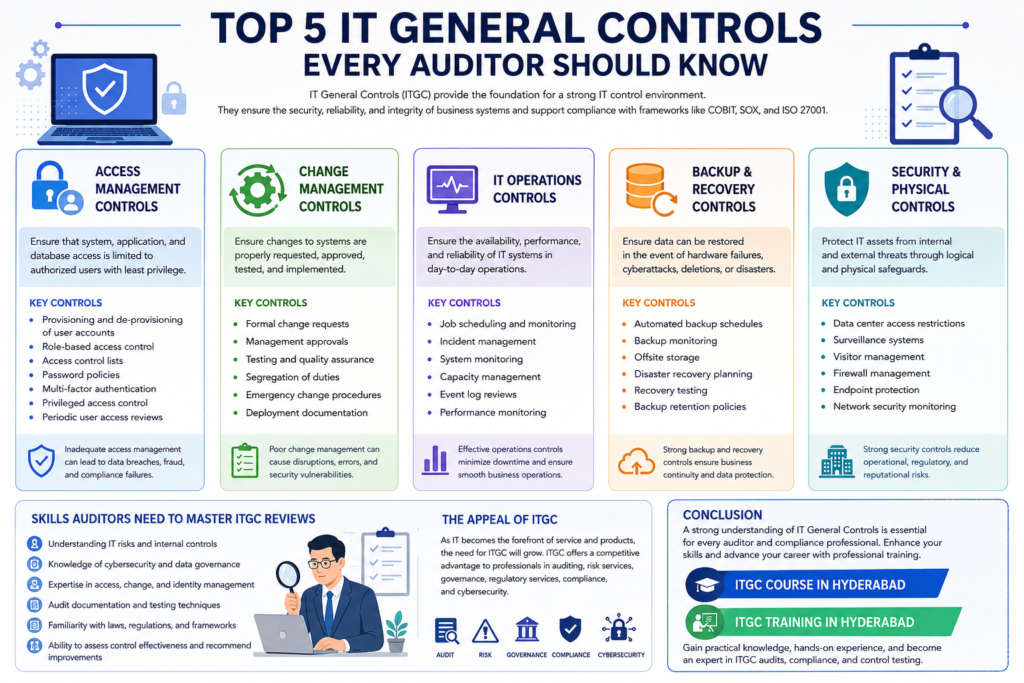
Businesses rely so much on information systems that auditors need to realize just how essential IT General Controls (ITGC) are. They understand the security, reliability, and integrity of business systems. IT General Controls (ITGC) provide the baseline, the building blocks of a business’s IT control environment. They help the business system’s data and processes from the risks of unauthorized access, failures and fraud. Strong ITGC help a business meet compliance and effective control objectives according to the frameworks of COBIT, SOX, and ISO 27001. For those that want to be IT auditors, internal auditors, compliance and/or risk management professionals, understanding ITGC is important. This article discusses the top five IT General Controls that every IT auditor should understand. What are IT General Controls? IT General Controls are the procedures and policies that focus on the confidentiality, accuracy, and availability of information control systems. They can be found in any IT environment in a large business and help application controls, business process controls, and organizational process IT systems. They include access controls, system operation controls, and controls for system backups and security. Poor ITGCs expose the business to operational disruptions, data loss, legal disputes, and false financial statements. Auditors evaluate the ITGC to determine the integrity of business IT. Why IT General Controls Matter in Auditing ITGCs have been called the essentials of IT governance and compliance. Where basic controls are lacking, auditors are likely to have little reliance on the automated or application-layer controls. For instance, if an unauthorized person is able to access a production system or make changes to it, the veracity of financial and operational data is in serious jeopardy. For the ITGCs, auditors consider: There are five critical IT General Controls all auditors should know. The first is Access Management Controls. 1. Access Management Controls Access Management is widely accepted as the most essential of all ITGC domain areas. These controls are focused on ensuring system, application, and database access is limited to individuals who have been authorized to access them. Access Management Controls are built around the concept of Least Privilege, where users are afforded only those permissions that are required in order for them to perform their job functions. Key Access Management Controls Access Management in ITGC audits is highly focused. This is because inadequate access management controls are frequently a cause of data breaches, system fraud, and IT compliance failures. 2. Change Management Controls Companies make changes to applications, infrastructure, and databases. This can be infrastructure / application / database changes. Change management controls document necessary steps like proper requests and approvals, testing changes, and implementation. Change management controls lack the integrity of management if poorly requested and tested changes can be made in production in a disruptive, incomplete, and insecure (for example, a data breach) manner. Key Change Management Controls Audit Procedures Audit may involve: Routine Audit Findings Change management controls lack integrity if controls are incomplete, for example if necessary change controls are not documented. Maintaining systems integrity and operational risks is the purpose for a comprehensive change management program. Change management is a crucial pillar of IT General Controls. 3. IT Operations Controls IT operations controls are concerned with the management and monitoring of IT systems in the operational phase. Controls assure that systems and processes operate without interruptions. Availability of IT operations is critical to the objectives of the organization. Key IT Operations Controls Audit Procedures Auditors may review: Common Audit Findings Four strong IT operations backup and recovery controls offer assurance that business disruption due to unexpected operational issues will be minimized. 4. Backup and Recovery Controls Backup and recovery controls protect one of the most critical recovery resource and asset that any organization possesses: its data. Recovery controls assist in the restoration of data in the event of hardware failures, cyberattacks, deletions, and disasters. These controls also help ensure business recovery is possible after a disruption. Organizations with inadequate backup procedures can incur significant loss of business and financial resources. Key Backup and Recovery Controls Audit Procedures Auditors review: Common Audit Findings Evidence of recovery testing is more critical to auditors than backup procedures. Organizations need to test their recovery procedures to ensure the data and systems can be restored in a timely manner. 5. Security & Physical Controls Security controls aim to keep IT assets safe from threats both inside the organization and externally. Both logical security measures and physical safeguards are included to stop access to facilities and infrastructures. Controls for both physical and logical security are important to the framework of ITGC. Key Security & Physical Controls Audit Procedures Auditors review: Common Audit Findings The lack of strong security controls puts organizations at operational, regulatory, and reputational risks. The management of security controls keeps systems and information safe, unaltered, and accessible. Skills Auditors Need to Master ITGC Reviews To perform the ITGC review competently, professionals will need to master IT risks, internal controls, the basics of cybersecurity, and the documentation of audits. Practical knowledge of laws and data governance, as well as the management of identities, access, and changes, will also be necessary. The ability of auditors to assess the effectiveness of controls and suggest improvements is greatly enhanced by practical knowledge of audit testing. The Appeal of ITGC As IT becomes the forefront of service and products, the need for ITGC will grow. ITGC offers a competitive advantage to professionals in auditing, risk services, governance, regulatory services, compliance, and cybersecurity. Hyderabad ITGC trainings can help you understand access management, change management, IT operations, and audit methods. If you aim to gain more experience, focusing on ITGC audits and compliance in Hyderabad can also help you practice more through audits, compliance methods, and control testing. Conclusion IT General Controls (ITGC) are the foundation of a secure, reliable, and compliant IT environment. From access management and change management to IT operations, backup and recovery, and security controls, these core areas help organizations protect critical systems and data while supporting business objectives. For auditors and
Top 5 IT General Controls Every Auditor Should Know Read More »